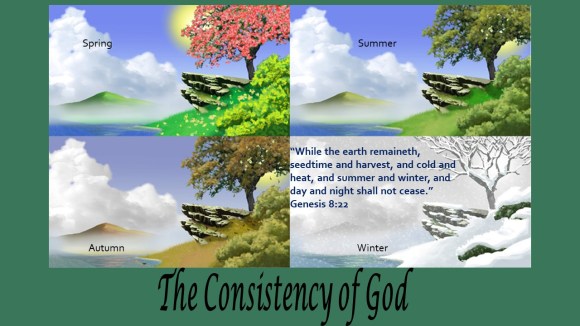
The Bible pictures God as all knowing. In eternity God knows all that will take place; therefore, He does not react to events. It is with absolute clarity in the creation of the world, the Father and His son gave angels and mankind the power to choose with its attendant evil that would result.
(Isaiah 46:9-10 [KJV])
Remember the former things of old: for I [am] God, and [there is] none else; [I am] God, and [there is] none like me, Declaring the end from the beginning, and from ancient times [the things] that are not [yet] done, saying, My counsel shall stand, and I will do all my pleasure:
(Psalms 33:6 [KJV])
By the word of the LORD were the heavens made; and all the host of them by the breath of his mouth.
(Psalms 33:9 [KJV]) For he spake, and it was [done]; he commanded, and it stood fast.
Since God cannot lie (Titus1:2), when He speaks, it is fact.
The Bible is clear that God does not change (Malachi 3:6). His behavior, attitude and character remain the same under all circumstances. The experience in the garden of Eden speaks clearly to God consistency in the face of evil. In spite of their sin, God came as he did the day before for the appointment that he had with Adam and his wife. It was not God that changed. All the changes that occurred were in the man and his wife. (See Genesis 3:8-13)
Based on a misguided understanding of God’s character, many in reading the Old Testament have come to believe that the God of the Old is different from the New.
We have already stated that God is all knowing. Therefore the development of sin did not take God by surprise. For in the counsel of peace (Zachariah 6 : 13) Christ was covenanted to be man’s redeemer before the world was. (See Revelation 13:8)
While it is true, that sin had a profound effect on creature and creation, it did not produce not one iota of change in God. Sin did what God could not do, in that it introduced death into the world. (Romans 5:12). Death is just not a characteristic of God.
The thief cometh not, but for to steal, and to kill, and to destroy: I am come that they might have life, and that they might have [it] more abundantly. (John 10:10 [KJV])
And ye will not come to me, that ye might have life. (John 5:40 [KJV])
I know that, whatsoever God doeth, it shall be forever: nothing can be put to it, nor any thing taken from it: and God doeth it, that men should fear before him. Ecclesiastes 3:14 (KJV)
Have I any pleasure at all that the wicked should die? saith the Lord God: and not that he should return from his ways, and live?… For I have no pleasure in the death of him that dieth, saith the Lord God: wherefore turn yourselves, and live ye. Ezekiel 18:23,32 (KJV)
We have established that God is all knowing. Therefore, to see God’s consistency we must journey back to the creation of angels and man. Knowing what would transpire, God had two choices. He could make angels and man as robots or could make them intelligent creatures with the ability to make decisions whether good or bad. Here we will see that His fore- knowledge did not change his behavior.
“Morals” is the common name for virtue, and virtue pertains to that which is right, good, true, and pure. It relates to conduct, and conduct relates to character. The essence of man is his character, and character is the sum of our daily habits. It enters into everything we do and become.
Could not God have made man so that he could not sin? The answer is no, He could not. If God made man so that he could not sin, it would have been equally to make him so that he could not do right, or to make him unintelligent. Mankind would be a creature machine, incapable of morals, and morals have to do with choice. Freedom of choice is essential to morals. Freedom to do right implies freedom to do wrong. If a man was made so that he could not do wrong, he would have no freedom at all, not even to do right. He would be less than the beast. There is no virtue in forced obedience, nor can there be any virtue in doing that which is right if it were impossible to do wrong.
Thus in His wisdom God created man upright, holy, and free, only “a little lower than the angels.” He gave to him Eden a paradise for his home, with dominion over the earth and over every living thing upon it, as His representative. God made to grow from the ground “every tree that is pleasant to the sight, and good for food,” and “the tree of life, which is in the midst of the paradise of God.” God gave to them everything that could please the eye, charm the senses, and delight the mind. He gave it all to the holy pair to be enjoyed by them forever. He made them free to enjoy or to refuse it. Choice is introduced. Therefore, God placed also in the midst of the garden the forbidden tree, “the tree of knowledge of good and evil.” “And the Lord God commanded the man, saying, of every tree of the garden thou mayest freely eat; but of the tree of the knowledge of good and evil, thou shalt not eat of it; for in the day that thou eatest thereof thou shalt surely die.“(Genesis 2:16-17) Thus for the man then, as for man forever, there was established the principle, “Choose you this day whom ye will serve:”
(Joshua 24:15)
In Eden the divine principle of self-government, and government with the consent of the governed was established.
In setting about to exercise their freedom of choice, the pair chose not to govern themselves but to sell themselves to Satan for naught, exchanging paradise for bondage to sin, death and lawlessness — immorality.
Yes, God saw all that and still chose to make man in His image. That is consistency.
**To be continued: Part 2 in 2 weeks**
 cryaloud.news