Categories
Bible Truths

“Wrestling”

The Present Truth 9, 38.

E. J. Waggoner

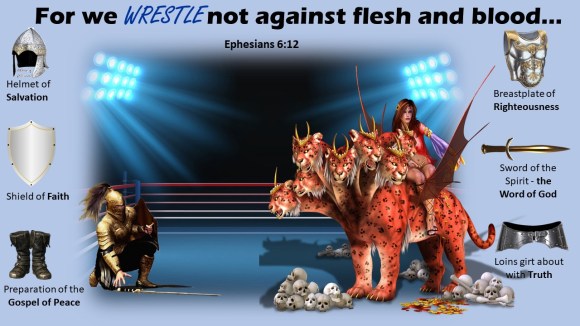
Wrestling was much more common in the ancient times than it is now, because warfare was then a hand-to-hand matter, and victory in a battle depended more on the athletic skill of the combatants, than it does these days of long-range rifles. The great battles were often little else than huge wrestling contests. This is why the Apostle Paul describes the warfare of the Christian as wrestling. “Put on the whole armor of God, that ye may be able to stand against the wiles of the devil. For we wrestle not against flesh and blood, but against principalities, against powers, against the rulers of the darkness of this world, against spiritual wickedness in high places.” Ephesians 6: 11, 12.This contest is to be carried on with the strength that the Lord gives, and the armor that He supplies. The wrestler is exhorted to “be strong in the Lord and in the power of His might.” Ephesians 6:10 He is to strive, but it is to be according to the working of God in him. Colossians 1: 29 The power all comes from God, and it is really God that gains the victory over the enemy, working through the man who yields to Him. Jesus says, “…In the world ye shall have tribulation; but be of good cheer; I have overcome the world.” John 16: 33 Therefore we read, “This is the victory that hath overcome the world, even our faith. And who is he that overcometh the world, but he that believeth that Jesus is the Son of God?” 1 John 5: 4, 5.

In the thirty-sixth Psalm, verses eleven and twelve, (Psalms 36:11, 12) we have a reference to this wrestling against the wickedness of this world. “Let not the foot of pride come against thee, and let not the hand of the wicked remove me. There are the workers of iniquity fallen; they are cast down, and shall not be able to rise.” The hands and feet play the principal part in wrestling. Each wrestler seeks to trip up his antagonist with his feet. There is no foot so dangerous in wrestling as the foot of pride, because “pride goeth before destruction and an haughty spirit before a fall.” (Proverbs 16: 18) Therefore it is that the psalmist prays to be kept from the foot of pride. Only He can keep us from this dangerous foe, because He is meek and lowly in heart. Whoever abides in Him will be kept from the pride of man.

It is an unfortunate thing that most people have made a wrong use of the account of Jacob’s wrestling with the angel, who was the Lord Jesus Himself. They read the account of His wrestling all night, and then in the morning receiving a blessing, and think that means that we are to wrestle with the Lord in order to get a blessing from Him. Because of this mistaken idea, many people fail to receive the blessings that they might otherwise have. Let us study the case a little.

WRESTLING AGAINST GOD

A moment’s thought should be sufficient to show us that the Lord is not our adversary. He is not opposed to us. Therefore we do not have to fight with Him. Wrestling is fighting, and it is a dangerous position for one to occupy, to be fighting against God. God is for us, to protect us from all that come against us. We do not want to fight with the only Friend we have.

But of course the idea of fighting is not in the minds of those who speak of wrestling with God. Their idea is that of striving with Him to get Him to give us His blessing. But God has come to us with His blessing before we ever felt the need of it. “Unto you first God, having raised up His Son Jesus, sent Him to bless you, in turning away every one of you from His iniquities.” Acts 3: 26 “He that spared not His own Son, but delivered Him up for us all, how shall He not with Him also freely give us all things?” Romans 8: 32 If we were half as anxious to receive the blessings of God as He is to bestow them upon us, we should have more than we ever dreamed of.

But did not Jacob wrestle all night with the Lord? Yes, he did, but do not forget that he did not know that it was the Lord. He thought all the time that it was an enemy. And that illustrates the position of those who think that they must wrestle with the Lord for a blessing. Unconsciously they are regarding the Lord as their adversary, instead of their Helper.

Now let us see what we are to learn from the case of Jacob. When was it that he first found that the One with whom he was wrestling was not a man, but the Lord Himself?-It was when the Angel put forth His hand, and put Jacob’s thigh out of joint with a touch. Read the account in Genesis 32: 24-28. How much longer did Jacob wrestle after he found out that he was wrestling with the Lord?-Not a minute, because such a thing was impossible. It was the dislocation of his thigh that made him know with whom he was wrestling; and no man can wrestle with a thigh out of joint. A man with his thigh out of joint would be at a greater disadvantage in wrestling, than a man with only one leg, because in addition to having only one leg to stand on, he would have the inconvenience and the intense pain of the useless one.

What, therefore, did Jacob do as soon as his dislocated thigh made known unto him with whom he was wrestling?-He did the only thing that he could do, namely, he threw his arms around the Lord for support. If one were wrestling or walking, or even standing still, and his thigh should suddenly be thrown out of joint, he would immediately fall to the ground. So Jacob would have fallen, if he had not held on to the Lord. And this we learn from the record. As soon as Jacob’s thigh was out of joint, the Angel said, “Let Me go, for the day breaketh.” And Jacob replied, “I will not let Thee go, except Thou bless me.” This shows, what we should naturally conclude, that as soon as Jacob learned that it was the Lord with whom he was wrestling, he ceased wrestling, and threw himself upon Him for support.

And it was then that Jacob prevailed. During all the night of wrestling he had not been able to gain anything, but as soon as he stopped wrestling with the Lord, and hung helpless upon Him, he gained a blessing. And so it will ever be. “For thus saith the Lord God, the Holy One of Israel; in returning and rest shall ye be saved; and quietness and in confidence shall be your strength.” Isaiah 30: 15 “Trust ye in the Lord for ever; for in the Lord Jehovah is everlasting strength.” Isaiah 26: 4.

Then instead of striving with the Lord, let us yield to Him, and allow Him to do our fighting for us. See Psalms 25: 1, 2. We shall find all that we wish to do, in keeping our wills subject to His. Power belongs to Him, and He will exert all in our behalf, if we will throw ourselves upon Him.

Categories
Bible Truths

True Christianity: Rome Against Christianity – Part 3

As Christianity began to take root in the Roman empire, the difference between Judaism and Christianity was clearly seen.  While Rome recognized the Jewish religion, the Christian religion was not granted permission to exist.  Therefore, a direct conflict began between Christianity and the most brutal and oppressive of all power, Rome.  Of Rome the Bible states, “Then I would know the truth of the fourth beast, which was diverse from all the others, exceeding dreadful, whose teeth [were of] iron, and his nails [of] brass; [which] devoured, brake in pieces, and stamped the residue with his feet”. (Daniel 7:19 [KJV])

A fundamental maxim of Roman legislation was, — “No man shall have for himself particular gods of his own; no man shall worship by himself any new or foreign gods, unless they are recognized by the public laws.” — Cicero.  [Page 348] Quoted in Neander’s “History of the Christian Religion and Church,” sec. i, div.iii, par. 2.  

It is very evident that in such a system there was no place for individuality. The State was everything, and the majority was in fact, the State. What the majority said should be, that was the voice of the State, that was the voice of “God”, that was the expression of the highest good, that was the expression of the highest conception of right; and everybody must assent to that or be considered a traitor to the State. The individual was but a part of the State. There was therefore no such thing as the rights of the people; the right of the State only was to be considered, and that was to be considered absolute. “The first principle of their law was the paramount right of the State over the citizen. Whether as head of a family, or as proprietor, he had no natural rights of his own; his privileges were created by the law as well as defined by it. The State in the plenitude of her power delegated a portion of her own irresponsibility to the citizen, who satisfied the conditions she required in order to become the parent of her children; but at the same time she demanded of him the sacrifice of his free agency to her own rude ideas of political expediency.” –– Merivale. [Page 349] “Romans under the Empire,” chap. xxii, par.21.

It is also evident that in such a system there was no such thing as the rights of conscience; because as the State was supreme also in the realm of religion, all things religious were to be subordinated to the will of the State, which was but the will of the majority. And where the majority presumes to decide in matters of religion, there is no such thing as rights of religion or conscience. Against this whole system Christianity was diametrically opposed. — {1898 ATJ, Great Empires of Prophecy (GEP) 349.2}

Christ had set himself before His disciples as the one possessing all power in heaven and in earth. He had told them to go into all the world and teach to every creature all things whatsoever He had commanded them. Christ had said that the first of all the commandments, that which inculcates the highest and first of all duties is, “And thou shalt love the Lord thy God with all thy heart, and with all thy soul, and with all thy mind, and with all thy strength:…” (Mark 12:30 [KJV]) This put Jesus Christ above the State, and put allegiance to Him above allegiance to the State; this denied the supremacy of Rome, and likewise denied either, that the Roman gods were gods at all, or that the genius of Rome itself was in any sense a god. {1898 ATJ, GEP 350.1}

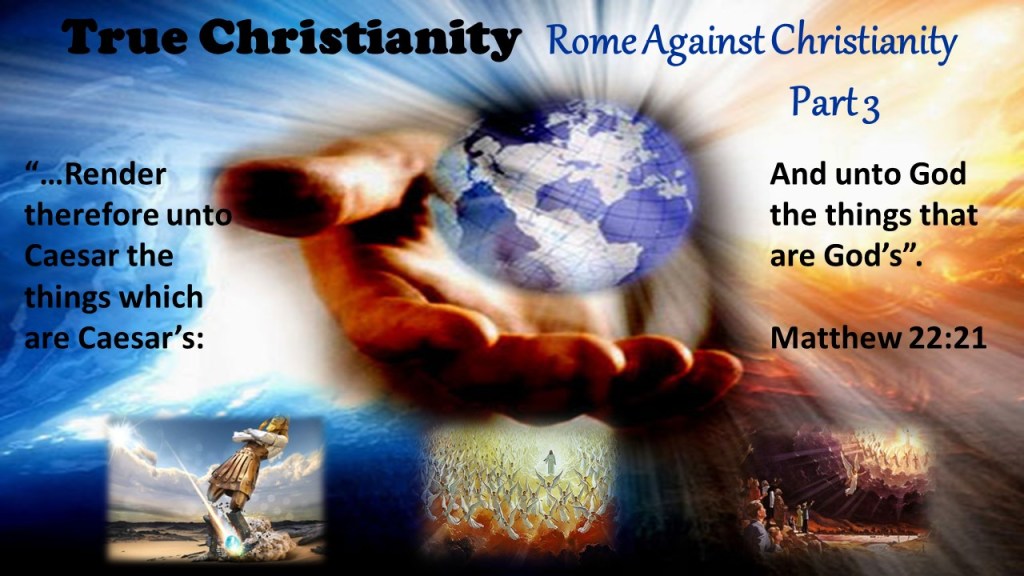
Christ when asked by the Pharisees and the Herodians whether it was lawful to give tribute to Caesar or not, answered: “Render therefore unto Caesar the things which are Caesar’s; and unto God the things that are God’s.” (Matthew 22:21 [KJV]) In this, Christ established a clear distinction between Caesar and God, and between religion and the State. He separated that which pertains to God from that which pertains to the State. Only that which was Caesar’s was to be rendered to Caesar, while that which is God’s was to be rendered solely to God.

Therefore when Christ made this distinction between God and Caesar, separated that which pertains to God from that which pertains to Caesar, and commanded men to render to God that which is God’s, and to Caesar only that which is Caesar’s, He at once stripped Caesar — the State — of every attribute of divinity. And in doing this, He declared the supremacy of the individual conscience; because it rests with the individual to decide what things they are which pertain to God. {1898 ATJ, GEP 350.4}

 Thus Christianity proclaimed the right of the individual to worship according to the dictates of his own conscience; Rome asserted the duty of every man to worship according to the dictates of the State. Christianity asserted the supremacy of God; Rome asserted the supremacy of the State. Christianity set forth God as manifested in Jesus Christ as the chief good; Rome held the State to be the highest good. Christianity set forth the law of God as the expression of the highest conception of right; Rome held the law of the State to be the expression of the highest idea of right. Christianity taught that the fear of God and the keeping of His commandments is the whole duty of man; Rome taught that to be the obedient servant of the State is the whole duty of man. Christianity preached Christ as the sole possessor of power in heaven and in earth; Rome declared the State to be the highest power. Christianity separated that which is God’s from that which is Caesar’s; Rome maintained that that which is God’s is Caesar’s.  {1898 ATJ, GEP 351.1}

With the distinction clearly made, to profess Christianity made you an enemy of the state, but such was the calling.  “And they overcame him by the blood of the Lamb, and by the word of their testimony; and they loved not their lives unto the death”. (Rev 12:11 [KJV])

Rome had a pantheon of gods, and every act of life was associated with the gods.  Every Christian, merely by the profession of Christianity, severed himself from all the gods of Rome and everything that was done in their honor. He could not attend a wedding or a funeral of his nearest relatives, because every ceremony was performed with reference to the gods. He could not attend the public festival, for the same reason. Nor could be escape by absenting himself on such occasions; because on days of public festivity, the doors of the houses, and the lamps about them, and the heads of the dwellers therein, must all be adorned with laurel and garlands of flowers in honor of the licentious gods and goddesses of Rome. If the Christian took part in these services, he paid honor to the gods as did the other heathen. If he refused to do so, which he must do if he would obey God and honor Christ, he made himself conspicuous before the eyes of the people, all of whom were intensely jealous of the respect they thought due to the gods. Also, in so refusing, the Christians disobeyed the Roman law, which commanded these things to be done. {1898 ATJ, GEP 358.1}

 All this subjected the Christians to universal hatred, and as the laws positively forbade everything that the Christians taught, both with reference to the gods and to the State, the forms of law furnished a ready channel through which this hatred found vent. This was the open way for the fury of the populace to spend itself upon the “deniers of the gods, and enemies of the Caesars and of the Roman people.” And this was the source of the persecution of Christianity by pagan Rome. 
{1898 ATJ, GEP 358.2}  

One of the ruling principles of law in the Roman State was this: — {1898 ATJ, GEP 359.4}

“Whoever introduces new religions, the tendency and character of which are unknown, whereby the minds of men may be disturbed, shall, if belonging to the higher rank, be banished; if to the lower, punished with death.” {1898 ATJ, GEP 359.5}

Nothing could be more directly condemned by this law than was Christianity. {1898 ATJ, GEP 359.6}

In spite of all this, Christianity flourished till it was said;  “ If ye continue in the faith grounded and settled, and [be] not moved away from the hope of the gospel, which ye have heard, [and] which was preached to every creature which is under heaven; whereof I Paul am made a minister; (Col 1:23 [KJV])

True Christianity was not only willing to suffer reproach but die for the sake of the gospel. Are you a true Christian?

“But what things were gain to me, those I counted loss for Christ. Yea doubtless, and I count all things [but] loss for the excellency of the knowledge of Christ Jesus my Lord: for whom I have suffered the loss of all things, and do count them [but] dung, that I may win Christ”. (Phil 3:7-8 [KJV])

Categories
Bible Truths

True Christianity: It’s Purpose – Part 2

Of Jesus it is said, “Behold the Lamb of God, which taketh away the sin of the world.” (John 1:29) He was sent to reveal the Father’s character amongst the most despotic of all nations, as a sheep among wolves.

Christ came to make men free, The Spirit of the Lord [is] upon me, because he hath anointed me to preach the gospel to the poor; he hath sent me to heal the brokenhearted, to preach deliverance to the captives, and recovering of sight to the blind, to set at liberty them that are bruised.” (Luke 4:18 [KJV])

The Roman Empire then filled the world,  “the sublimest incarnation of power, and a monument the mightiest of greatness built by human hands, which has upon this planet been suffered to appear.” That empire, proud of its conquests, and exceedingly jealous of its claims, asserted its right to rule in all things, human and divine. In the Roman view, the State took precedence of everything. It was entirely out of respect to the State and wholly to preserve the State, that either the emperors or the laws ever forbade the exercise of the Christian religion. According to Roman principles, the State was the highest idea of good. “The idea of the State was the highest idea of ethics, and within that was included all actual realization of the highest good; hence the development of all other goods pertaining to humanity, was made dependent on this.” — Neander. 5  {1898 ATJ, Great Empires of Prophecy (GEP) 346.4}

 Man with all that he had, was subordinate to the State; he must have no higher aim than to be a servant of the State; he must seek no higher good than that which the State could bestow. Thus every Roman citizen was a subject, and every Roman subject was a slave. “The more distinguished a Roman became, the less was he a free man. The omnipotence of the law, the despotism of the rule, drove him into a narrow circle of thought and action, and his credit and influence depended on the sad austerity of his life. The whole duty of man, with the humblest and greatest of the Romans, was to keep his house in order, and be the obedient servant of the State.” — Mommsen. 6   {1898 ATJ, GEP 347.1}

Jesus Christ came into the world to set men free, and to plant in their souls the genuine principle of liberty, — liberty actuated by love, liberty too honorable to allow itself to be used as an occasion to the flesh or for a cloak of maliciousness. Liberty led by a conscience enlightened by the Spirit of God, liberty in which man may be free from all men, yet made so gentle by love that he would willingly become the servant of all, in order to bring them to the enjoyment of this same liberty. This is freedom indeed. This is the freedom which Christ gave to man; for “whom the Son makes free is free indeed.” {1898 ATJ, GEP 346.1}

Rome in conquering the nations, did not interfere with their religious services.  To the Romans, all religion was simple superstition. See Acts 25:19.

The conquered is allowed to worship, as long as they acknowledge that Caesar is God above all others, in another word, Caesar was the supreme “God”. 

The controversy that arose between the Christians and the Romans was not a dispute between individuals, or a contention between sects or parties. It was a contest between antagonistic principles.  Christianity demanded absolute freedom of conscience, the right of the individual to worship God as he or she saw fit.  On the part of Rome, it was the assertion that Caesar was the highest and every other god is subservient to Caesar. Caesar was the State and the State rules in all things, divine as well as human, religious as well as civil.

It became clear that for any man to profess the principles and the name of Christ was virtually to set himself against the Roman Empire.  For him to recognize God as revealed in Jesus Christ as the highest good, was but treason against the Roman State. It was not looked upon by Rome as anything else than high treason; because, as the Roman State represented to the Roman the highest idea of good, for any man to assert that there was a higher good, was to make Rome itself subordinate. And this would be a direct blow at the dignity of Rome, and subversive of the Roman State. Consequently the Christians were not only called “atheists,” because they denied the gods, but the accusation against them before the tribunals was of the crime of “high treason,” because they denied the right of the State to interfere with men’s relations to God. The common accusation against them was that they were “irreverent to the Caesars, and enemies of the State and Caesar.

In trying to trap Jesus the Pharisees asked; “Is it lawful to give tribute unto Caesar, or not?  “ Then saith he unto them, Render therefore unto Caesar the things which are Caesar’s; and unto God the things that are God’s.” (Matt 22:21 [KJV])

With this declaration, Jesus made it clear that Caesar’s role was civil only, and everything dealing with conscience is to God.  He made it clear that Caesar was not God.  To the Christians were given the commands, “Thou shalt have no other gods before me” (Exodus  20:1). Thou shalt worship the Lord thy God, and him only shalt thou serve”.  
(Matt 4:10 [KJV])“Look unto me, and be ye saved, all the ends of the earth: for I [am] God, and [there is] none else”. (Isa 45:22 [KJV]) These texts were clear and there could be no compromise. 

Therefore to acknowledge Christianity and profess that you are a follower was literally a death sentence.  That has always and will always be the path to true Christianity.  Then said Jesus unto his disciples, If any [man] will come after me, let him deny himself, and take up his cross, and follow me.” (Matt 16:24 [KJV])

In matters of conscience the soul must be left untrammeled. No one is to control another’s mind, to judge for another, or to prescribe his duty. God gives to every soul freedom to think, and to follow his own convictions. “Every one of us shall give account of himself to God”. No one has a right to merge his own individuality in that of another. In all matters where principle is involved, “let every man be fully persuaded in his own mind”. (Romans 14:12, 5). In Christ’s kingdom there is no lordly oppression, no compulsion of manner. Desire of Ages (DA) 551

True Christianity  is founded and built on  liberty of conscience.  See (Acts chapter 4 and  5:17-33).  He who follows the multitude to force one to violate his conscience is not Christian.    

“For I am come to set a man at variance against his father, and the daughter against her mother, and the daughter in law against her mother in law.  And a man’s foes [shall be] they of his own household.  He that loveth father or mother more than me is not worthy of me: and he that loveth son or daughter more than me is not worthy of me.  And he that taketh not his cross, and followeth after me, is not worthy of me.  He that findeth his life shall lose it: and he that loseth his life for my sake shall find it”. (Matt 10:35-39 [KJV])

**True Christianity: The Conclusion. Part 3 to follow**