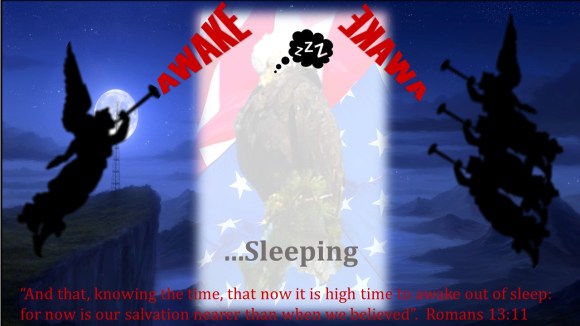
It is from the wise man Solomon who declares that history always repeats itself. See Ecclesiates 1:9-10; 3:15.
History is a road map whereby we know where we are going.
“The disadvantage of men not knowing the past is they do not know the present. History is a hill or high point of vantage, from which alone men see the town in which they live or the age in which they are living”. {C.K.Chesterton 1933}
“We can chart our future clearly and wisely only when we know the path which has led to the present”. {Adlai Stevenson, 1952}
America is at a cross road and seems to have forgotten how she ascended the ladder to world dominance. Thus the lessons which should keep her are forgotten. The lessons of the fall of Babylon, Medio-Persia, Greece, Rome, Britain, Spain, and France are lost in time; hence their mistakes are been followed.
In his book, “The Peril of the Republic of the United States of America” Dr. Percy T Magan, carefully lays out the founding principles that established this nation. What follows are his thoughts. We hope it will open eyes to see where we truly are in time.
The wonderful words of James Russell Lowell apply just as much to the present time as to any time in past history:- “Careless seems the great Avenger: history’s pages but record One death-grapple in the darkness ‘twixt false systems and the Word. Truth forever on the scaffold, Wrong forever on the throne; yet that scaffold sways the future, and behind the dim unknown standeth God within the shadow, keeping watch above his own.”
The advent of the United States upon history’s stage broke the dawn of a new era, not alone for the Old Thirteen, but for all mankind. The principles of freedom enunciated in the immortal Declaration of Independence were pregnant with weal for tens of thousands in other climes, and for millions then unborn, as well as for the embattled farmers who fought at Lexington and Concord. {1899 PTM, PRUS 9.1}
The new nation appealed not to tables of dynasty and royal succession to prove her title to life or her right to existence as a sovereign state among peers. Discarding these, her founders bore her into the arena upon certain self-evident truths. Her people assumed their equal and separate station among the powers of the earth by “the laws of nature and of nature’s God.” 1 {1899 PTM, PRUS 9.2}
Hitherto the doctrine had prevailed that the Almighty had created one class to govern and another class to be governed. Statesmen had universally held that all men were not created equal, and ecclesiastics had not been slow in seconding their teachings. When from time-to-time philosophers had arisen inculcating ideas of liberty and equality, they had been branded as anarchists by the state and as atheists by the church. Many a time both the civil and religious powers had buried their own differences of opinion and claims of jurisdiction in order that they might form a union for the sole purpose of more effectively dealing swift and summary punishment to these disturbers of the existing order of things. The rack, the fagot, and all the ingenious and exquisite tortures which the Inquisition could devise had been freely employed to wring from unwilling lips the desired recantation.
Prior to the time of our glorious Revolution the doctrine that governments derive their just powers from the consent of the governed was wholly unknown in national practice. The princes and potentates of the nations of Europe had entrenched themselves behind that wickedest of all political tenets, the divine right of kings. This they amplified till it might better have read, the divine right of kings to govern wrong. With the aid of this as their creed, they had outraged in their subjects the inborn sense of manhood to such an extent that by the time the close of the eighteenth century was reached it was well-nigh extinct; and the majority of the human family, worn out by the struggle of centuries, were about to sink into a long sleep of political death from which it seemed almost impossible that there should be an awakening.
But the spark of light and life still burned; and a few bold sentences, the reflection of a few brave hearts, kindled a pillar of fire to guide mankind out of the wilderness of medieval political errors into the Canaan of governmental truth. As are the ten commandments and the golden rule in divinity, so are the precepts that governments derive their just powers from the consent of the governed, and that all men are created equal, in civility. The Declaration of Independence and the Constitution of the United States are indeed the New and Old Testaments in things pertaining to Cæsar, the one serving as a commentary in the light of which the other must be interpreted. Immortal are the words of Jefferson, the sage of Monticello; grand in their simplicity and “noble roughness:”-
“When, in the course of human events, it becomes necessary for one people to dissolve the political bands which have connected them with another, and to assume, among the powers of the earth, the separate and equal station to which the laws of nature and of nature’s God entitle them, a decent respect to the opinions of mankind requires that they should declare the causes which impel them to the separation.
“We hold these truths to be self-evident, that all men are created equal; that they are endowed by their Creator with certain unalienable rights; that among these are life, liberty, and the pursuit of happiness; that to secure these rights, governments are instituted among men, deriving their just powers from the consent of the governed.“
The Declaration of Independence is a declaration of great general principles, as well as a recital of certain specific grievances. It was never written to meet the exigencies of one particular time or people. No nation prior to this one had ever declared it as a principle good for all mankind that all men are created equal, or that governments derive their just powers from the consent of the governed. None of the great nations of Europe ever taught or ever believed these precepts. They were born simultaneously with the American Republic. They constituted her christening robe and her birthright, peculiarly her own, and the first infant cry of her national life. That nation of the old world which has ever been the foremost in promulgating doctrines of freedom and liberty did not believe these things, for she it was who fought them. She did not even believe them in their most limited sense for her most limited self,-the isle of England, as distinguished from colony and dependency. Much less, therefore, did she consider them as divine and immortal truths, applicable to all times and places, and worthy of being the basis of government among men in every kindred and nation and tongue and tribe and people.
Well has Charles Sumner said:- “The words that governments derive their just powers from the consent of the governed are sacred words, full of life-giving energy. Not simply national independence was here proclaimed, but also the primal rights of all mankind. Then and there appeared the angel of human liberation, speaking and acting at once with heaven-born strength, breaking bolts, unloosing bonds, and opening prison doors; always ranging on its mighty errand, wherever there are any, no matter of what country or race, who struggle for rights denied; now cheering Garibaldi at Naples, as it had cheered Washington in the snows of Valley Forge, and especially visiting all who are downtrodden, whispering that there is none so poor as to be without rights which every man is bound to respect, none so degraded as to be beneath its beneficent reach, none so lofty as to be above its restraining power; while before it despotism and oligarchy fall on their faces, like the image of Dagon, and the people everywhere begin to govern themselves.”
And again he says:- “These words in the Declaration of Independence were not uttered in vain. Do you suppose them idle? Do you suppose them mere phrase or generality? No such thing. They are living words, by which this country is solemnly bound, and from which it can never escape until they are fulfilled. Your statutes can not contain any limitation which inflicts an indignity upon any portion of the human family.” And yet again:- “The Declaration of Independence is the twofold promise; first, that all are equal in rights, and secondly, that just government stands only on the consent of the governed, being the two great political commandments on which hang all laws and constitutions. Keep these truly, and you will keep all. Write them in your statutes; write them in your hearts. This is the great and only final settlement of all existing questions. To this sublime consecration of the Republic let us aspire.” {1899 PTM, PRUS 12.2}
Don’t miss Part 2 of this message in 2 weeks.
 cryaloud.news