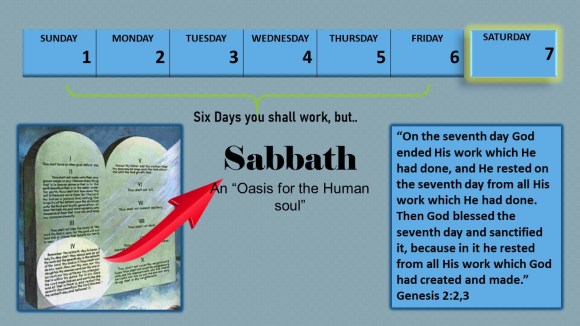
In presenting “The Unchanging Nature of the Law”, clearly showing that by dying to redeem humanity, Christ has shown that the law is binding on all men and could not be changed to meet man in his fallen condition. It stands to reason, that if the law (Ten Commandments) could be changed or abolished, then Christ need not die. All He had to do was change it. Scripture is clear, “All have sinned” and “the wages of sin is death” Romans 3:23 and 6:23. That law is still waiting to condemn any like Adam who has sinned.
After this I was presented with a youtube video of a polished speaker claiming that the “law” was abolished and showing reasons to accept Sunday. In response I will let J.N. Andrews answer his objections which follow below.
AN EXAMINATION OF SEVEN REASONS FOR SUNDAY-KEEPING Continued: Reasons three through seven.
THIRD REASON. After eight days, Jesus met with his disciples again. John 20:26. This must have been the first day of the week, which is thereby proved to be the Christian Sabbath. {1889 JNA, ESRS 10.1}
Were it certain that this occurred on the first day of the week, it would not furnish a single particle of proof that that day had become the Sabbath of the Lord. But who can be certain that “after eight days” means just a week? It would be nearer a literal construction of the language to conclude that this was upon the ninth day. As an illustration, read Matthew 17:1: “And after six days, Jesus taketh Peter, James, and John,” etc. Now turn to Luke 9:28: “And it came to pass about eight days after these sayings, he took Peter, and John, and James,” etc. Then, “after six days” is about eight days in this instance. But if “after eight days” means just a week, how does this prove that Sunday has taken the place of the Lord’s Sabbath? Rather, how does it prove that Sunday has become the Christian Sabbath, when there is not a particle of evidence that either Christ or his apostles ever rested on that day? There is no such term as Christian Sabbath found in the Bible. The only weekly Sabbath named in the Bible is called the Sabbath of the Lord. {1889 JNA, ESRS 10.2} Was the act of Christ in appearing to his disciples sufficient to constitute the day on which it occurred the Sabbath? If so, why did he next select a fishing day as the time to manifest himself to them? John 21. If it is not sufficient, then the Sunday on which he was first seen of them, the fishing day on which they next saw him, and the Thursday on which he was last seen of them, may not be Sabbaths. It was not very remarkable that Christ should find his disciples together, inasmuch as they had one common abode. Acts 1:13. {1889 JNA, ESRS 11.1}
FOURTH REASON. The Holy Spirit descended upon the disciples on the day of Pentecost, which was the first day of the week. Therefore, the first day of the week should be observed instead of the Sabbath of the Lord. Acts 2:1,2. {1889 JNA, ESRS 11.2}
Admitting that the day of Pentecost occurred upon the first day of the week, it remains to be proved that that day thereby became the Sabbath. But that it was the feast of Pentecost, and not the first day of the week, that God designed to honor, the following facts demonstrate: – {1889 JNA, ESRS 11.3}
1. While the day of Pentecost is distinctly named, the day of the week on which it occurred is passed in silence. {1889 JNA, ESRS 11.4}
2. The disciples had been engaged in earnest prayer for the space of ten days; for the day of Pentecost was fifty days from the resurrection of Christ, and forty of those days he spent with his disciples. Acts 1. Forty days from his resurrection would expire on Thursday, the day of his ascension. A period of ten days after his ascension on Thursday would include two first-days, the last of which would be the day of Pentecost. If the design of God had been to honor the first day of the week, why did not the Holy Ghost descend on the first of those first-days? Why must the day of Pentecost come before the Holy Ghost could descend? This answer is obvious: It was not the design of Heaven to honor the first day of the week, but to mark the antitype of the feast of Pentecost. Hence the first day of the week is passed in silence. {1889 JNA, ESRS 11.5}
The slaying of the paschal lamb on the fourteenth day of the first month had met its antitype in the death of the Lamb of God on that day. Exodus 12; John 19; 1Corinthians 5:7. The offering of the first-fruits on the sixteenth day of the first month had met its antitype in the resurrection of our Lord on that day, the first-fruits of them that slept. Leviticus 23; 1Corinthians 15:20-23. It remained that the day of Pentecost, fifty days later, should also meet its antitype. Leviticus 23:15-21. The fulfillment of that type is what the pen of inspiration has recorded in Acts 2:1,2. God has spoken nothing in this place respecting a change of his Sabbath. Yet grave men, calling themselves Doctors of Divinity, consider this text one of their strongest testimonies for their so-called Christian Sabbath. They might be profited by this advice of the wise man: “Add thou not unto his words, lest he reprove thee, and thou be found a liar.” Proverbs 30:6. {1889 JNA, ESRS 12.1}
FIFTH REASON. Paul once broke bread upon the first day of the week at Troas. Hence this day was observed as the Christian Sabbath. Acts 20:7. {1889 JNA, ESRS 12.2}
We answer that at one period the apostolic church at Jerusalem broke bread every day. Acts 2:42-46. If a single instance of breaking bread at Troas upon the first day of the week was quite sufficient to constitute it the Sabbath, would not the continued practice of the apostolic church at Jerusalem in breaking bread every day be amply sufficient to make every day a Sabbath? Moreover, as the act of the great Head of the church in breaking bread must be quite as important as that of his servant Paul, must not the day of the crucifixion be pre-eminently the Christian Sabbath, as Christ instituted and performed this ordinance on the evening with which that day commenced? 1Corinthians 11:23-26. {1889 JNA, ESRS 12.3}
But on what day of the week did this act of Paul’s occur? For, if it is of sufficient importance to make the day of its occurrence the future Sabbath of the church, the day is worth determining. The act of breaking bread was after midnight; for Paul preached to the disciples until midnight, then healed Eutychus, and after this attended to breaking bread. Acts 20:7-11. If, as time is reckoned at the present day, the first day of the week terminated at midnight, then Paul’s act of breaking bread was performed upon the second day of the week, or Monday, which should henceforth be regarded as the Christian Sabbath, if breaking bread on a day makes it a Sabbath. {1889 JNA, ESRS 13.1}
But, if the Bible method of commencing the day, viz., from sunset, was followed, it would appear that the disciples came together at the close of the Sabbath for an evening meeting, as the apostle was to depart in the morning. If it was not an evening meeting, why did they have many lights there? Paul preached unto them until midnight, and then broke bread with the disciples early in the morning of the first day of the week. Did this act constitute that day the Sabbath? If so, then why did Paul, as soon as it was light, start on his long journey to Jerusalem? If Paul believed that Sunday was the Christian Sabbath, why did he thus openly violate it? If he did not believe it had become the Sabbath, why should you? And why do you grasp, as evidence that the Sabbath has been changed, a single instance in which an evening meeting was held on Sunday, while you overlook the fact that it was the custom of this same apostle to preach every Sabbath, not only to the Jews, but also to the Gentiles? Acts 13:14,42,44; 16:13; 17:2; 18:4. {1889 JNA, ESRS 13.2}
Paul broke bread on the first day of the week, and then immediately started on his long journey to Jerusalem. So that this, the strongest argument for the first day of the week, furnishes direct proof that Sunday is not the Sabbath. {1889 JNA, ESRS 14.1}
SIXTH REASON. Paul commanded the church at Corinth to take up a public collection on the first day of the week; therefore, it follows that this must have been a day of public worship, and consequently is the Christian Sabbath. 1Corinthians 16:2. {1889 JNA, ESRS 14.2}
We answer, it is a remarkable fact that Paul enjoins exactly the reverse of a public collection. He does not say, place your alms in the public treasury on the first day of the week; but he says, “Upon the first day of the week let every one of you lay by him in store.” {1889 JNA, ESRS 14.3}
J. W. Morton, in his “Vindication of the True Sabbath,” pp.51,52, says: – {1889 JNA, ESRS 14.4}
“The apostle simply orders that each one of the Corinthian brethren should lay up at home some portion of his weekly gains on the first day of the week. The whole question turns upon the meaning of the expression, ‘by him;’ and I marvel greatly how you can imagine that it means ‘in the collection-box of the congregation.’ Greenfield, in his Lexicon, translates the Greek term, ‘by one’s self, i.e., at home.’ Two Latin versions, the Vulgate and that of Castellio, render it, ‘apud se,’ with one’s self, at home. Three French translations, those of Martin, Osterwald, and De Sacy, ‘chez soi,’ at his own house, at home. The German of Luther, ‘bei sich selbst,’ by himself, at home. The Dutch, ‘by hemselven,’ same as the German. The Italian of Diodati, ‘appresso di se,’ in his own presence, at home. The Spanish of Felipe Scio, ‘en su casa,’ in his own house. The Portuguese of Ferreira, ‘para isso,’ with himself. The Swedish, ‘noer sig self,’ near himself. I know not how much this list of authorities might be swelled; for I have not examined one translation that differs from those quoted above.” {1889 JNA, ESRS 14.5}
The text, therefore, does not prove that the Corinthian church was assembled for public worship on that day; but, on the contrary, it does prove that each must be at his own home where he could examine his worldly affairs, and lay by himself in store as God had prospered him. If each one should thus, from week to week, collect his earnings, when the apostle should come their bounty would be ready, and each would be able to present to him what he had gathered. So that, if the first-day Sabbath has no better foundation than the inference drawn from this text, it truly rests upon sliding sand. {1889 JNA, ESRS 15.1}
SEVENTH REASON. John was in the Spirit on the Lord’s Day, which was the first day of the week. Revelation 1:10. {1889 JNA, ESRS 15.2}
This is the kind of reasoning which the advocates of Sunday are invariably obliged to adopt. But we ask, what right have they to assume the very point which they ought to prove? This text, it is true, furnishes direct proof that there is a day in the gospel dispensation which the Lord claims as his; but is there one text in the Bible which testifies that the first day of the week is the Lord’s Day? There is not one. Has God ever claimed that day as his? Never. Has God ever claimed any day as his, and reserved it to himself? He has. “And God blessed the seventh day and sanctified it; because that in it he had rested from all his work which God created and made.” Genesis 2:3. “To-morrow is the rest of the holy Sabbath unto the Lord.” Exodus 16:23. “The seventh day is the Sabbath of the Lord thy God.” Exodus 20:10. “If thou turn away thy foot from the Sabbath, from doing thy pleasure on my holy day,” etc. Isaiah 58:13. “Therefore the Son of man is Lord also of the Sabbath.” Mark 2:28. {1889 JNA, ESRS 15.3}
Then the seventh day is the day which God reserved to himself when he gave to man the other six; and this day he calls his holy day. This is the day which the New Testament declares the Son of man to be Lord of. {1889 JNA, ESRS 16.1}
Is there one testimony in the Scriptures that the Lord of the Sabbath has put away his holy day and chosen another? Not one. Then that day which the Bible designates as the Lord’s Day is none other than the Sabbath of the fourth commandment.
BY J. N. ANDREWS. PACIFIC PRESS PUBLISHING COMPANY, 1889.
 cryaloud.news