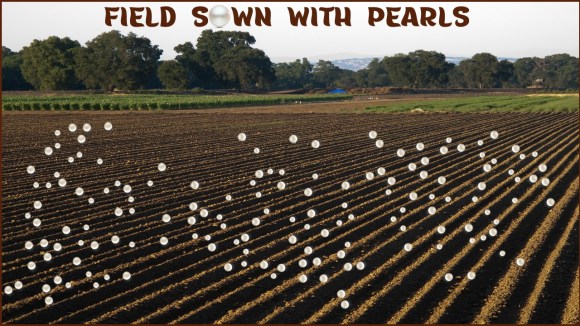
One day while doing my devotion in the am, I came across a statement, “field sown with pearls”. Pearls are costly and beautiful gems. They may be luminous in their beauty, valuable, but are barren of life. A field sown with pearls can produce no life. Somehow those words, “field sown with pearls” arrested my attention. Was my Christian life and experience like a field sown with pearls? Outward beauty but devoid of life. Am I just a professed Christian, going to church, reading my bible, having daily prayer and weekly bible studies but not fully surrendered, struggling with obedience? Am I living a life motivated to tell others about the matchless love of God and His sacrifice to save mankind before it is too late? Am I living a life of righteousness because Christ abides in me? “ Jesus saith unto him, I am the way, the truth, and the life:..” John 14:6 Sobering questions. I began to search out answers to these questions.
Some answers are hard to acknowledge. Hebrews 4:12 says,” For the word of God is quick, and powerful, and sharper than any two-edged sword, piercing even to the dividing asunder of soul and spirit, and of the joints and marrow, and is a discerner of the thoughts and intents of the heart. “ However, the truth is very necessary if we are to be overcomers in this battle for our salvation. The answer lies in the fact that our hearts must be changed for our lives to be transformed. God must do this work for us.
This excerpt helped me with the answer. Christ Object Lessons (COL), Chapter 7, Like unto Leaven:
“Often the question arises, Why, then, are there so many, claiming to believe God’s word, in whom there is not seen a reformation in words, in spirit, and in character? Why are there so many who cannot bear opposition to their purposes and plans, who manifest an unholy temper, and whose words are harsh, overbearing, and passionate? There is seen in their lives the same love of self, the same selfish indulgence, the same temper and hasty speech, that is seen in the life of the worldling. There is the same sensitive pride, the same yielding to natural inclination, the same perversity of character, as if the truth were wholly unknown to them. The reason is that they are not converted. They have not hidden the leaven of truth in the heart. It has not had opportunity to do its work. Their natural and cultivated tendencies to evil have not been submitted to its transforming power. Their lives reveal the absence of the grace of Christ, an unbelief in His power to transform the character. COL 99.1
“Faith cometh by hearing, and hearing by the word of God.” Romans 10:17. The Scriptures are the great agency in the transformation of character. Christ prayed, “Sanctify them through Thy truth; Thy word is truth.” John 17:17. If studied and obeyed, the word of God works in the heart, subduing every unholy attribute. The Holy Spirit comes to convict of sin, and the faith that springs up in the heart works by love to Christ, conforming us in body, soul, and spirit to His own image. Then God can use us to do His will. The power given us works from within outwardly, leading us to communicate to others the truth that has been communicated to us. COL 100.1
“The truths of the word of God meet man’s great practical necessity—the conversion of the soul through faith. These grand principles are not to be thought too pure and holy to be brought into the daily life. They are truths which reach to heaven and compass eternity, yet their vital influence is to be woven into human experience. They are to permeate all the great things and all the little things of life. COL 100.2
Received into the heart, the leaven of truth will regulate the desires, purify the thoughts, and sweeten the disposition. It quickens the faculties of the mind and the energies of the soul. It enlarges the capacity for feeling, for loving. COL 101.1
The world regards as a mystery the man who is imbued with this principle. The selfish, money-loving man lives only to secure for himself the riches, honors, and pleasures of this world. He loses the eternal world from his reckoning. But with the follower of Christ these things will not be all-absorbing. For Christ’s sake he will labor and deny self, that he may aid in the great work of saving souls who are without Christ and without hope in the world. Such a man the world cannot understand; for he is keeping in view eternal realities. The love of Christ with its redeeming power has come into the heart. This love masters every other motive, and raises its possessor above the corrupting influence of the world. COL 101.2
The word of God is to have a sanctifying effect on our association with every member of the human family. The leaven of truth will not produce the spirit of rivalry, the love of ambition, the desire to be first. True, heaven-born love is not selfish and changeable. It is not dependent on human praise. The heart of him who receives the grace of God overflows with love for God and for those for whom Christ died. Self is not struggling for recognition. He does not love others because they love and please him, because they appreciate his merits, but because they are Christ’s purchased possession. If his motives, words, or actions are misunderstood or misrepresented, he takes no offense, but pursues the even tenor of his way. He is kind and thoughtful, humble in his opinion of himself, yet full of hope, always trusting in the mercy and love of God. COL 101.3
The apostle exhorts us, “As He which hath called you is holy, so be ye holy in all manner of conversation; because it is written, Be ye holy; for I am holy.” 1 Peter 1:15, 16. The grace of Christ is to control the temper and the voice. Its working will be seen in politeness and tender regard shown by brother for brother, in kind, encouraging words. An angel presence is in the home. The life breathes a sweet perfume, which ascends to God as holy incense. Love is manifested in kindness, gentleness, forbearance, and long-suffering. COL 102.1
The countenance is changed. Christ abiding in the heart shines out in the faces of those who love Him and keep His commandments. Truth is written there. The sweet peace of heaven is revealed. There is expressed a habitual gentleness, a more than human love. COL 102.2
The leaven of truth works a change in the whole man, making the coarse refined, the rough gentle, the selfish generous. By it the impure are cleansed, washed in the blood of the Lamb. Through its life-giving power it brings all there is of mind and soul and strength into harmony with the divine life. Man with his human nature becomes a partaker of divinity. Christ is honored in excellence and perfection of character. As these changes are effected, angels break forth in rapturous song, and God and Christ rejoice over souls fashioned after the divine similitude. COL 102.3
The closing gem: The answer is revealed.
“As the leaven, when mingled with the meal, works from within outward, so it is by the renewing of the heart that the grace of God works to transform the life. No mere external change is sufficient to bring us into harmony with God. There are many who try to reform by correcting this or that bad habit, and they hope in this way to become Christians, but they are beginning in the wrong place. Our first work is with the heart. COL 97.1
A profession of faith and the possession of truth in the soul are two different things. The mere knowledge of truth is not enough. We may possess this, but the tenor of our thoughts may not be changed. The heart must be converted and sanctified. COL 97.2
Amen!

 cryaloud.news