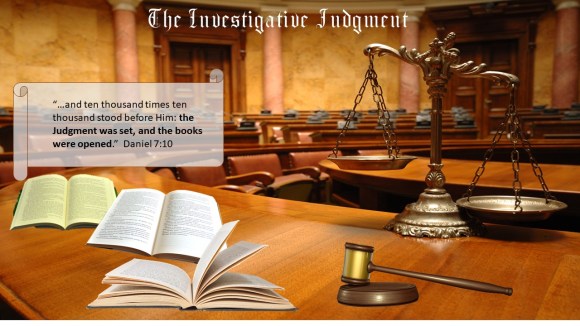
The disappointment of 1844 among Advent believers concerning the coming of Messiah, and subsequent regrouping as the understanding of the sanctuary developed, led the believers to diligently search out their mistake. From this development, the Seventh Day Adventist movement was later formed. As the Sanctuary became the focus of study, a series of truth were established, among them, The Investigative Judgment. To this topic, most Protestant came to view as a ‘face saving devise’. Over the years many have stumbled over the idea that there is a need of an investigative judgment. This is quite unfortunate. There is abundant evidence for the investigative judgment. There can be no just judgment without prior investigation.
In his article on “The Judgment, its Event and Their Order (JEO)” JN Andrews (JNA) clearly laid out the argument why there is a ‘Book of Life’, and the ‘Book of Remembrance’. It is from these that all life reviews take place and then judgment is executed. That is investigation. We will now allow this pioneer to speak.
CHAPTER 2 – EXAMINATION OF THE BOOKS
The Book of Life – The Book of Remembrance – Blotting out of Sins – Blotting out of Names – Judgment Precedes Resurrection – A Solemn Decree – Closing Work of Our High Priest
THE existence of records, or books, in heaven and their use in the judgment, is plainly revealed. Thus Daniel says, “The judgment was set, and the books were opened.” Daniel 7:10. And John says: “And I saw the dead, small and great, stand before God; and the books were opened; and another book was opened, which is the book of life; and the dead were judged out of those things which were written in the books, according to their works.” Revelation 20:12. {1890 JNA, JEO 15.1}
It is evident that the utmost importance is attached to the blotting out of the sins of the righteous from these books. When they are blotted out they can never rise up in the judgment against those who committed them; for men give account to God only for those things contained in the books. It is therefore certain that no individual can have his sins blotted out until the close of his probation. But when this work is wrought there must be an examination of the books for this very purpose. {1890 JNA, JEO 15.2}
The book of life is to be examined before the resurrection of the just. The words of Daniel render this point perfectly clear: {1890 JNA, JEO 15.3}
“And at that time shall Michael stand up, the great prince which standeth for the children of thy people; and there shall be a time of trouble, such as never was since there was a nation even to that same time; and at that time thy people shall be delivered, every one that shall be found written in the book.” Daniel 12:1. {1890 JNA, JEO 15.4}
We have seen from other texts that the investigation and decision of the judgment in the cases of the righteous precedes the advent of the Saviour. We have also seen that there is a time before the coming of Jesus when the sins of the righteous are blotted out from the books of God’s remembrance. This is decisive proof that these books are subjected to examination before the Saviour comes again. But we have now another important fact. The book of life is examined before the deliverance of the saints. Daniel says, “At that time thy people shall be delivered, every one that shall be found written in the book.” The book must, therefore, be examined before the resurrection of the righteous to immortal life. This is another convincing proof that the investigation of the cases of the righteous precedes the first resurrection. This book is referred to in the following passages: Exodus 32:32,33; Psalms 69:28; 87:6; Isaiah 4:3; Ezekiel 13:9; Daniel 12:1; Luke 10:20; Philippians 4:3; Hebrews 12:23; Revelation 3:5; 13:8; 17:8; 20:12,15; 21:27; 22:19. {1890 JNA, JEO 16.1}
The book of life is the final means of determining the cases of the righteous in the judgment; for all are delivered who are at the time of deliverance found written in it. But before this book is made the final source of appeal, it is itself to be tested by the books of God’s record. For all the names which are entered in this book of life, of those who fail to overcome, are to be blotted out. Yet it is the record of these persons’ lives that is to cause their names to be stricken from the book of life. Exodus 32:32,33; Psalms 69:28; Revelation 3:5. We must, therefore, conclude that before the final examination of the book of life in the case of the righteous, there is a prior examination of the books of God’s record to determine (1) whose record of repentance and of overcoming is such that their sins shall be blotted out, and (2) to ascertain from this book who have failed in the attempt to overcome, and to strike the names of all such from the book of life. When the books of God’s remembrance are thus examined, and the sins of the overcomers blotted out, and the names of those who have not overcome are removed from the book of life, that book becomes the final test, and an examination of its pages concludes the work of investigation preparatory to the deliverance of the saints. {1890 JNA, JEO 16.2}
We have seen that though the book of life is the final book of reference to determine who shall have part in the first resurrection, yet it must itself first be examined by the book of God’s remembrance, for the removal of the name of every person who has not completed the work of overcoming. {1890 JNA, JEO 17.1}
1. The book called “the book of remembrance” is written expressly for the righteous, and is the book which shall determine, in their cases, the decision of the judgment. This book is particularly referred to in the following passages: {1890 JNA, JEO 17.2}
“Then they that feared the Lord spake often one to another; and the Lord hearkened, and heard it, and a book of remembrance was written before him for them that feared the Lord, and that thought upon his name. And they shall be mine, saith the Lord of hosts, in that day when I make up my jewels; and I will spare them, as a man spareth his own son that serveth him. Then shall ye return, and discern between the righteous and the wicked, between him that serveth God and him that serveth him not.” Malachi 3:16-18. {1890 JNA, JEO 17.3}
“Thou tellest my wanderings; put thou my tears into thy bottle; are they not in thy book?” Psalms 56:8. {1890 JNA, JEO 18.1}
“Remember me, O my God, concerning this, and wipe not out my good deeds that I have done for the house of my God, and for the offices thereof.” Nehemiah 13:14. {1890 JNA, JEO 18.2}
The book of God’s remembrance mentioned in these texts pertains only to the righteous; yet it appears to be a different book from the book of life; for though that book belongs alone to the righteous, it seems to be simply the record of their names (Luke 10:20; Philippians 4:3; Revelation 3:5; 13:8; 17:8), while the book of remembrance is the record of their good deeds. Malachi 3:16-18; Psalms 56:8; Nehemiah 13:14. But should we conclude that the book of life is identical with the book of God’s remembrance, it will not essentially change this argument, for it would still follow that the record of the good deeds of the righteous, if it shows that they have overcome all their faults, and perfected the graces of the Spirit of God in themselves, is that which determines that their names shall be retained in the book of life, and their sins blotted out of the books which record them. But if the record be not such as God can accept, then their names must be removed from that book (Exodus 32:32,33; Psalms 59:28; Revelation 3:5), and the record of their good deeds also be blotted out, to be no more remembered. Nehemiah 13:14; Ezekiel 3:20. {1890 JNA, JEO 18.3}
The book of God’s remembrance contains the names of all who enter the service of God, and of such only. Yet not every one of these follows on to know him. Many that set out to overcome do not complete the work. That record, however, will show just how far they advanced in overcoming, and how and when they failed. As it contains simply the good deeds of the righteous, it will show their acts of repentance, confession, obedience, and sacrifice recorded therein. When the work is complete, then this record shows them prepared for the examination of the judgment. This, therefore, is the book out of which the cases of the righteous are to be decided, and from whose record they are to be accounted worthy of that world and the resurrection from the dead. {1890 JNA, JEO 19.1} End of excerpt.
There is a third book involved in the investigative judgment which is a record of the sins of men. A record of those who have never acknowledged the sacrifice of Jesus Christ for the salvation of mankind and have walked contrary to the gospel. Ecclesiastes 12:14; Matthew 12:36, 37; 1 Corinthians 4:5; Isaiah 65:6, 7.
This third book will be covered in greater detail in a subsequent blog on the Investigative Judgment which will elaborate on the points given above.
 cryaloud.news