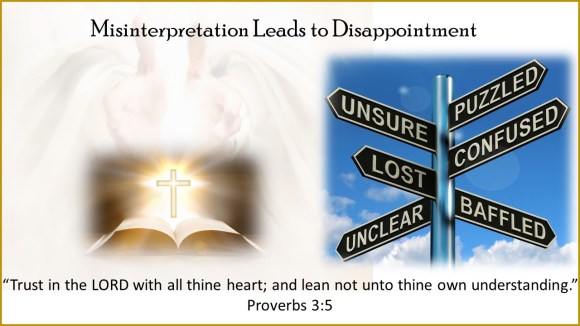
“Study to shew thyself approved unto God, a workman that needeth not to be ashamed, rightly dividing the word of truth.” (2 Timothy 2:15 [KJV])
“Jesus answered and said unto them, Ye do err, not knowing the scriptures, nor the power of God.” (Matthew 22:29 [KJV])
“Wherefore I was grieved with that generation, and said, They do alway err in [their] heart; and they have not known my ways.” (Hebrews 3:10 [KJV])
These scripture reference points introduce an issue that always arises among believers. Reading the scriptures but applying our faulty understanding and yet insisting that others yield to our understanding. The Spirit of the Lord has declared that must not be so.
“Thus saith the LORD; Cursed [be] the man that trusteth in man, and maketh flesh his arm, and whose heart departeth from the LORD.” (Jeremiah 17:5 [KJV])
“Trust in the LORD with all thine heart; and lean not unto thine own understanding. In all thy ways acknowledge him, and he shall direct thy paths. Be not wise in thine own eyes: fear the LORD, and depart from evil.” (Proverbs 3:5-7 [KJV])
“O LORD, I know that the way of man [is] not in himself: [it is] not in man that walketh to direct his steps.” (Jeremiah 10:23 [KJV])
“After this He went down to Capernaum, He, and His mother, and His brethren, and His disciples: and they continued there not many days. And the Jews’ Passover was at hand, and Jesus went up to Jerusalem.” {John 2:12}, {Desire of Ages (DA) 154.1}
In this journey, Jesus joined one of the large companies that were making their way to the capital. He had not yet publicly announced His mission, and He mingled unnoticed with the throng. Upon these occasions, the coming of the Messiah, to which such prominence had been given by the ministry of John, was often the theme of conversation. The hope of national greatness was dwelt upon with kindling enthusiasm. Jesus knew that this hope was to be disappointed, for it was founded on a misinterpretation of the Scriptures. With deep earnestness He explained the prophecies, and tried to arouse the people to a closer study of God’s word. {DA 154.2}
As I write, there is a great conflict going on between Israel and the Palestinians. The term “from the river to sea” is often used, with the intention of violence with its usage. Truly, God spoke these words to Abraham in Genesis 15.
(Genesis 15:17-18 [KJV])
“And it came to pass, that, when the sun went down, and it was dark, behold a smoking furnace, and a burning lamp that passed between those pieces. In the same day the LORD made a covenant with Abram, saying, Unto thy seed have I given this land, from the river of Egypt unto the great river, the river Euphrates.”
The question to ask is what did Abraham understand by this?. The promise was twofold. If Abraham and his seed would remain faithful to the Lord, then the Lord would grant them this land. However, faithfulness was lacking on the part of Abraham’s children. The consequences of this was, all the great powers that rule over Israel actually controlled from the river to the sea.
In 2 Kings 24, we see both Egypt and Babylon had dominion over that particular area.
(2 Kings 24:7 [KJV])
And the king of Egypt came not again any more out of his land: for the king of Babylon had taken from the river of Egypt unto the river Euphrates all that pertained to the king of Egypt.
AT Jones in his booklet “Christian Patriotism (CHPA)” shares Abraham’s understanding of the promise. Please consider his argument.
When God said to Abraham, “Get thee out of thy country, and from thy kindred, and from thy father’s house, unto a land that I will show thee,” Abraham “went out, not knowing whither he went.” Hebrews 11:8. {1900 ATJ, CHPA 18.1}
God had not yet shown to him the land or country into which he was to go, and which was to be his. So far, the Lord had only promised to show it to him. {1900 ATJ, CHPA 18.2}
There were three things, however, which Abraham must do before he could fairly expect God to show him the country which He had promised, and which was to be his. First, he was to get out of his country; secondly, from his kindred; thirdly, from his father’s house. {1900 ATJ, CHPA 18.3}
He left his country; but when he did so, his father and his kindred went with him to Haran, and dwelt there. There his father died; and now, separated from his father’s house, he went on to the land of Canaan. {1900 ATJ, CHPA 18.4}
But there accompanied him yet one of his kindred– Lot, his brother’s son. While Lot was with him, and he was thus not separated from his kindred, though separated from his country and his father’s house, the time did not come for God to show to him the land, nor the country which He would give him. {1900 ATJ, CHPA 18.5}
But there came a day when Lot should be separated from him. Lot chose all the plain of the Jordan, and journeyed east, and “they separated thus, one from the other.” Genesis 13:11. {1900 ATJ, CHPA 19.1}
And just then it was that God showed Abraham the land which He had promised to show him, the country which should be his. “And the Lord said unto Abraham, after that Lot was separated from him, Lift up now thine eyes, and look from the place where thou art northward, and southward, and eastward, and westward; for all the land which thou seest, to thee will I give it, and to thy seed forever.” Genesis 13:14, 15. {1900 ATJ, CHPA 19.2}
And the country which the Lord then showed to Abraham, and which He there promised him should be his for an everlasting possession–that country embraced the world; for “the promise, that he should be the heir of the world, was not to Abraham, or to his seed, through the law, but through the righteousness of faith.” Romans 4:13. {1900 ATJ, CHPA 19.3}
Therefore, when at the word of the Lord Abraham lifted up his eyes to see what the Lord would show him, he saw “the world to come,” which is to be the everlasting possession of all them which be of faith. For “if ye be Christ’s, then are ye Abraham’s seed, and heirs according to the promise.” Galatians 3:29. {1900 ATJ, CHPA 19.4}
And from that day forward Abraham “sojourned in the land of promise as in a strange country,” looking for “a better country, that is, an heavenly,” and looking “for a city which hath foundations, whose builder and maker is God.” Hebrews 11:9, 16, 8. For, though God promised that He would give to Abraham that land, and to his seed after him, yet as long as he was in this world God really “gave him none inheritance in it, no not so much as to set his foot on.” Acts 7:5. {1900 ATJ, CHPA 19.5}
So also dwelt Isaac and Jacob, heirs with Abraham of the same promise, accepting with Abraham separation from every earthly State and country, confessing “that they were strangers and pilgrims on the earth,” looking for the country which God had prepared for them, and the city which hath foundations, whose builder and maker is God. {1900 ATJ, CHPA 21.2}
And that they accepted this freely of their own choice, by faith in God, is shown by the fact, as recorded: “Truly, if they had been mindful of that country from whence they came out, they might have had opportunity to have returned. But now they desire a better country, that is, an heavenly; wherefore God is not ashamed to be called their God, for He hath prepared for them a city.” Hebrews 11.15, 16. {1900 ATJ, CHPA 21.3}
This dealing of God with Abraham, and the record of it, were for the instruction of all the people who would believe God, from that time to the world’s end. For Abraham was the called, the chosen, the friend of God, the father of all them that believe. And all “they which be of faith are blessed with faithful Abraham.” Galatians 3:9.
Further: “Now to Abraham and his Seed were the promises made. He saith not, And to seeds, as of many; but as of one, And to thy Seed, which is Christ.” Galatians 3:16. Therefore the promises recorded and referred to in the scripture, “To Abraham and his Seed,” are always to Abraham and Christ, and to Abraham in Christ. And, therefore, “if ye be Christ’s, then are ye Abraham’s seed, and heirs according to the promise.” Galatians 3:29. {1900 ATJ, CHPA 22.1} Amen.
 cryaloud.news