Categories
Bible Truths

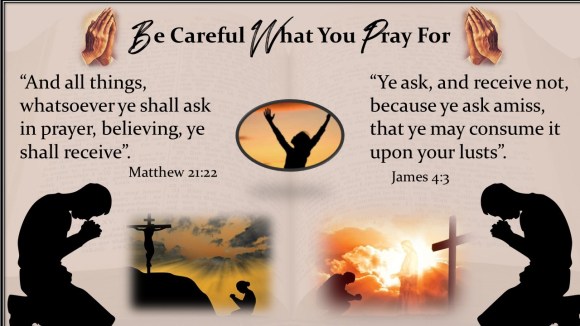
Be Careful What You Pray For

As the bird by wandering, as the swallow by flying, so the curse causeless shall not come. (Proverbs 26:2 [KJV])

In the creation of the world, God set the principles by which all things operate.  This is known as the seed principle or sowing and reaping. 

And he said, “Whereunto shall we liken the kingdom of God? or with what comparison shall we compare it?  [It is] like a grain of mustard seed, which, when it is sown in the earth, is less than all the seeds that be in the earth: But when it is sown, it groweth up, and becometh greater than all herbs, and shooteth out great branches; so that the fowls of the air may lodge under the shadow of it”.
(Mark 4:30-32 [KJV])

Being familiar with mustard seeds, and how tiny they are, it is no small wonder that a mustard seed cast into a field, competes against so many other plants until it outgrows the others.  Only a God of wonders could invest the mustard with such vitalizing power to withstand all obstacles it faces and rise above it all, thus achieving its full potential. 

So amidst evil, God wants his people to bud, blossom and bloom and bring forth fruit to His glory. “And Moses laid up the rods before the LORD in the tabernacle of witness.  And it came to pass, that on the morrow Moses went into the tabernacle of witness; and, behold, the rod of Aaron for the house of Levi was budded, and brought forth buds, and bloomed blossoms, and yielded almonds”. (Numbers 17:7-8 [KJV])

In the lives of most people, the decisions they make early often fashion the outcome of their life. This is sowing and reaping.  While individuals form groups and groups form nations, this dynamic rarely changes. Often the decision of one or a few affect a whole nation.  As nations, many of the leaders are elected.  Those who are seeking offices and those that elect them pay little attention to what matters most in the individual.  Character, is often overlooked, yet it is one of the most essential aspects of one’s life.  Remember, “Righteousness exalteth a nation: but sin [is] a reproach to any people”.
(Proverbs 14:34 [KJV])

The life of Hezekiah presented to us a wonderful lesson.  Hezekiah was the  son of A’haz, a wicked king, who practiced wickedness.  See (2 Chronicles 28:19-25). Thus as a legacy, Hezekiah saw and received wickedness.  Hezekiah, having seen what his father did chose a different path.  The scripture record of Him in the early years as king is such; “Hezekiah began to reign [when he was] five and twenty years old, and he reigned nine and twenty years in Jerusalem. And his mother’s name [was] Abijah, the daughter of Zechariah. And he did [that which was] right in the sight of the LORD, according to all that David his father had done”. (2 Chronicles 29:1-2 [KJV])
He had a very prosperous reign, a life that he should be thankful for.
See 2 Chronicles, chapters 29-32.  In his days Isaiah was the prophet, and we read;

“In those days was Hezekiah sick unto death. And Isaiah the prophet the son of Amoz came unto him, and said unto him, Thus saith the LORD, Set thine house in order: for thou shalt die, and not live. Then Hezekiah turned his face toward the wall, and prayed unto the LORD,  And said, Remember now, O LORD, I beseech thee, how I have walked before thee in truth and with a perfect heart, and have done [that which is] good in thy sight. And Hezekiah wept sore.  Then came the word of the LORD to Isaiah, saying,  Go, and say to Hezekiah, Thus saith the LORD, the God of David thy father, I have heard thy prayer, I have seen thy tears: behold, I will add unto thy days fifteen years”. (Isaiah 38:1-8 [KJV])

Being a very successful king, news of his sickness spread far and wide.  In granting him fifteen years and the miracle of the sundial going back ten degrees, the Babylonians heard and came to inquire.  With the miracle fresh in his mind, one would think he would lift up the God of Heaven, but no; he showed all the gold and silver in his kingdom. Thus; “Then came Isaiah the prophet unto king Hezekiah, and said unto him, What said these men? and from whence came they unto thee? And Hezekiah said, They are come from a far country unto me, [even] from Babylon. Then said he, What have they seen in thine house? And Hezekiah answered, All that [is] in mine house have they seen: there is nothing among my treasures that I have not shewed them. Then said Isaiah to Hezekiah, Hear the word of the LORD of hosts: Behold, the days come, that all that [is] in thine house, and [that] which thy fathers have laid up in store until this day, shall be carried to Babylon: nothing shall be left, saith the LORD. And of thy sons that shall issue from thee, which thou shalt beget, shall they take away; and they shall be eunuchs in the palace of the king of Babylon. (Isaiah 39:3-7 [KJV])

The actions of Hezekiah started a chain of circumstances which caused the house of Judah to go into captivity. Daniel and his companions, Ezekiel, Jeremiah and all that came from that family, down to Zedekiah, the last king of Judah.
In pleading for his life, Hezekiah suggested that God was not fair and that God did not know what was best. God gave him his desire, but showed what was in his heart. 

“Howbeit in [the business of] the ambassadors of the princes of Babylon, who sent unto him to enquire of the wonder that was [done] in the land, God left him, to try him, that he might know all [that was] in his heart”. (2 Chronicles 32:31 [KJV])

Hezekiah had a son born in the third year of that probationary time. The outworking of Manasseh’s life testified that Hezekiah not only failed concerning the ambassador, but as a father.  It is amazing that a son born at that time knowing what has been done to his father could practice such wickedness.  “Because Manasseh king of Judah hath done these abominations, [and] hath done wickedly above all that the Amorites did, which [were] before him, and hath made Judah also to sin with his idols: Therefore thus saith the LORD God of Israel, Behold, I [am] bringing [such] evil upon Jerusalem and Judah, that whosoever heareth of it, both his ears shall tingle. And I will stretch over Jerusalem the line of Samaria, and the plummet of the house of Ahab: and I will wipe Jerusalem as [a man] wipeth a dish, wiping [it], and turning [it] upside down”.
(2 Kings 21:11-13 [KJV])

Scripture is clear that God is too wise to err, and too good to withhold any good thing from them that walk uprightly.
Hezekiah pressing a perverse will caused the death of tens of thousands, through his son and great grandsons. 
“And I will cause them to be removed into all kingdoms of the earth, because of Manasseh the son of Hezekiah king of Judah, for [that] which he did in Jerusalem”. (Jeremiah 15:4 [KJV])

Lessons we need to learn.. Trust in the LORD with all thine heart; and lean not unto thine own understanding”. (Proverbs 3:5 [KJV])
Categories
Bible Truths

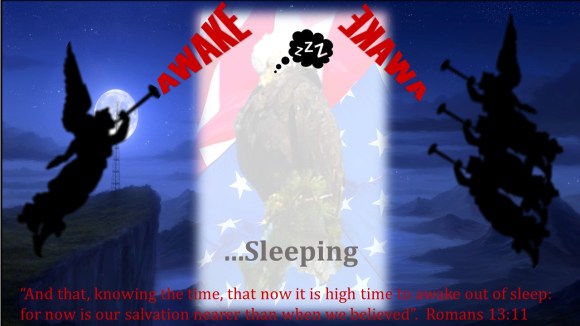
America Awake! Thy Destiny is before Thee. (Part 2)

Part 2

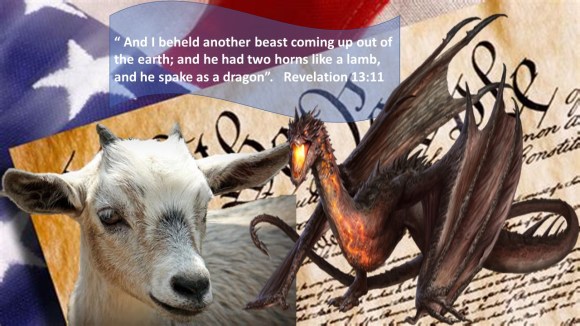
Having understood for a long time that Revelation 13:11-18 deals expressly with America, and that the Bible records history in accordance to its effect on the people of God, I have often wondered at statements such as: “When our nation, in its legislative councils, shall enact laws to bind the consciences of men in regard to their religious privileges, enforcing Sunday observance, and bringing oppressive power to bear against those who keep the Seventh-day Sabbath, the law of God will, to all intents and purposes, be made void in our land, and national apostasy will be followed by national ruin”.—Volume 7 Bible Commentary (7BC) 977 (1888).  {Last Day Events (LDE) 133.5} 

     It is at the time of the national apostasy when, acting on the policy of Satan, the rulers of the land will rank themselves on the side of the man of sin. It is then the measure of guilt is full. The national apostasy is the signal for national ruin.—Selected Messages Book 2 (2SM) 373 (1891).  {LDE 134.1}     

It is now clear why heaven called it apostasy.  The study continues.

In liberty, therefore, was the nation conceived; to these two propositions was it sacredly dedicated and solemnly sealed in the blood of its noblest sons. As the Bible declares that all men are equal before the Lord i.e., that God is no respecter of persons, so the Declaration affirms that all men are equal before the law, and that this equality is their own unalienable and primal right. The Declaration does not mean that all men are equal in all respects. But it does mean and it does say that they are equal in their right to life, liberty, and the pursuit of happiness. And in this it recognizes the nobility of man as the creation of God, and makes no exception or distinction in favor of any human caste or human lineage. “Obviously, men are not born equal in physical strength or in mental capacity, in beauty of form or in health of body. Diversity or inequality in these respects is the law of creation. But this inequality is in no particular inconsistent with complete civil or political equality. 

“The equality declared by our fathers in 1776, and made the fundamental law of Massachusetts in 1780, was equality before the law. Its object was to efface all political or civil distinctions, and to abolish all institutions founded upon birth. ‘All men are created equal,’ says the Declaration of Independence. ‘All men are born free and equal,’ says the Massachusetts Bill of Rights. These are not vain words. Within the sphere of their influence, no person can be created, no person can be born, with civil or political privileges not enjoyed equally by all his fellow citizens; nor can any institutions be established, recognizing distinctions of birth. Here is the great charter of every human being drawing vital breath upon this soil, whatever may be his conditions, and whoever may be his parents. He may be poor, weak, humble, or black; he may be of Caucasian, Jewish, Indian, or Ethiopian race; he may be born of French, German, English, or Irish extraction; but before the constitution of Massachusetts all these distinctions disappear. He is not poor, weak, humble, or black; nor is he Caucasian, Jew, Indian, or Ethiopian; nor is he French, German, English, or Irish; he is a man, the equal of all his fellow-men. . . . To some it [the state] may allot higher duties, according to higher capacities; but it welcomes all to its equal hospitable board. The state, imitating the divine justice, is no respecter of persons.”

This is the true doctrine of civil government; this is the Bible doctrine for civil government. {1899 Dr. Percy T. Magan (PTM), The Peril of the Republic of the United States of America (PRUS) 13.1}

There is still another principle in the Declaration of Independence which is worthy of notice here. The doctrine of the nations of medieval times was that “might makes right.” If a nation possessed enough arbitrary power and physical force to accomplish a certain end, no matter how criminally aggressive, no matter how tyrannical or despotic that end might be, the power to do was always supposed to prove the rightfulness of the thing done. And back of this time, in the dawn of European history, in the days of the Roman Republic, that nation had held to the doctrine of “Vox Populi vox Dei,”-“The voice of the people is the voice of God;” in other words, the Roman doctrine was that if the majority of the people approved of a thing, it must be right.  (For example, added emphasis, Vaccine Mandates).

But the Declaration of Independence, with one simple yet sweeping statement, disowns, disclaims, and discards both the Roman and the medieval theories, and substitutes in their place a principle beyond comparison with them for its lofty and holy teachings. In the last paragraph of that immortal document it is written that these United Colonies as free and independent States “have full power to levy war, conclude peace, contract alliances, establish commerce, and to do all other acts and things which independent States may of right do.”  Wrapped in these words was a new doctrine. Here was the enunciation of a principle hitherto unheard of. Heretofore sovereignty had been considered as being unlimited and illimitable. But the Declaration of Independence brought to the birth a new principle, that right is superior to all earthly power, whether vested in prince or potentate or in a republican form of government. With the founders of this government it was not a question of what the nation was able to do, but contrariwise, what was right for the nation to do. I quote once more from the great Sumner:-   “But the great Declaration, not content with announcing certain rights as unalienable, and therefore beyond the control of any government, still further restrains the sovereignty, which it asserts by simply declaring that the United States have ‘full power to do all acts and things which independent States may of right do.’ Here is a well-defined limitation upon the popular sovereignty. The dogma of Tory lawyers and pamphleteers-put forward to sustain the claim of parliamentary omnipotence, and vehemently espoused by Dr. Johnson in his ‘Taxation no Tyranny’-was taught, that sovereignty is in its nature illimitable, precisely as it is now loosely professed by Mr. Douglas for his handful of squatters. But this doctrine is distinctly discarded in the Declaration, and it is frankly proclaimed that all sovereignty is subordinate to the rule of right. Mark, now, the difference: all existing governments at that time, even the local governments of the colonies, stood on power without limitation. Here was a new government, which, taking its place among the nations, announced that it stood only on right, and claimed no sovereignty inconsistent with right.” 3

In 1837 John Quincy Adams in a Fourth of July oration at Newburyport, said:-

“The sovereign authority conferred upon the people of the colonies by the Declaration of Independence could not dispense them, nor any individual citizen of them, from the fulfilment of their moral obligations. The people who assumed their equal and separate station among the powers of the earth, by the laws of nature’s God, by that very act acknowledged themselves bound to the observance of those laws, and could neither exercise nor confer any power inconsistent with them.”
Still further alluding to the self-imposed restraints upon the sovereignty which had been established, he said:- “The Declaration acknowledged the rule of right paramount to the power of independent States itself, and virtually disclaimed all power to do wrong. This was a novelty in the moral philosophy of nations, and it is the essential point of difference between the system of government announced in the Declaration of Independence and those systems which had until then prevailed among men. . . . It was an experiment upon the heart of man. All the legislators of the human race until that day had laid the foundations of all government among men in power; and hence it was that in the maxims of theory, as well as in the practice of nations, sovereignty was held to be unlimited and illimitable. The Declaration of Independence proclaimed another law, . . . a law of right, binding upon nations as well as individuals, upon sovereigns as well as upon subjects. . . . In assuming the attributes of sovereign power, the colonists appealed to the Supreme Judge of the world for the rectitude of their intentions, and neither claimed nor conferred authority to do anything but for right.”  

Well indeed has George Bancroft, America’s greatest historian, said:- “This immortal state paper, which for its composer was the aurora of enduring fame, was ‘the genuine effusion of the soul of the country at that time,’ the revelation of its mind, when, in its youth, its enthusiasm, its sublime confronting of danger, it rose to the highest creative powers of which man is capable. The bill of rights which it promulgates is of rights that are older than human institutions, and spring from the eternal justice that is anterior to the state.”

In the Book of books it is written that “the grass withereth, the flower fadeth: but the word of our God shall stand forever;”(Isaiah 40:8) and in another place that that immortal Word “liveth and abideth forever.”(1 Peter1:23)  And it is even so with the great principles of the Declaration of Independence and of the Constitution of the United States. They are coeval with time, and they will be commensurate with eternity. The government of God in the beautiful world to come will be a government of love, a government founded upon the principles of the consent of the governed; for every soul in that blest home and kingdom, and in all the infinite universe, will desire naught else but that God and Jesus Christ shall rule. This will be the supreme and ever-living desire of every one. Heaven’s government is indeed one deriving its powers, which are only just, from the consent of the governed. Every voice in the righteous nation blends in that glad chorus: “Worthy is the Lamb that was slain to receive power, and riches, and wisdom, and strength, and honor, and glory, and blessing.” Says John, the revelator: “Every creature which is in heaven, and on the earth, and under the earth, and such as are in the sea, and all that are in them, heard I saying, “Blessing, and honor, and glory, and power, be unto him that sitteth upon the throne, and unto the Lamb forever and ever.” (Revelation 5:12-13) {1899 PTM, PRUS 16.6}

Many  years ago James Russell Lowell was asked by that great French historian,  Guizot, how long the Republic of the United States might reasonably be expected to endure. “So long,” replied Mr. Lowell, “as the ideas of its founders continue dominant.” {1899 PTM, PRUS 17.1}
No truer answer than this could possibly have been given. The United States obtained its national charter from the hand of Providence with the distinct understanding that its cardinal principles of government should forever be liberty and equality; and also with the express stipulation that the rule of right should always be paramount to the power of the sovereign State. {1899 PTM, PRUS 17.2}
If the Republic shall ever permanently desert these great principles, the star of her genius will set forevermore.  By that foul act of disloyalty and treason to “the laws of nature and of nature’s God,” she will forfeit her own right to “life, liberty, and the pursuit of happiness.” Woe be the day when she shall deny these unalienable rights, these precious God-given boons, to any portion of the family of mankind. In that selfsame hour the bloodless hand will once again trace the dread writing on the national wall: Mene, Mene, Tekel, Upharsin,-God hath numbered thy kingdom and finished it. Thou art weighed in the balances and found wanting. To her it will be said, “Reward her even as she rewarded others, and double unto her double according to her works: in the cup which she hath filled, fill to her double.” {1899 PTM, PRUS 17.3}

If we shall ever deny to others the right of government by their own consent, by such a deed we shall ourselves surrender to the Creator the charter of our national life, of our corporate existence. {1899 PTM, PRUS 18.1}
How far have we come from that history?
As nations cannot be rewarded or punished in the next world, they must be in this. By an inevitable chain of causes and effects, Providence punishes national sins by national calamities.”

Categories
Bible Truths

America Awake! Thy Destiny is before Thee. (Part 1)

It is from the wise man Solomon who declares that history always repeats itself. See Ecclesiates 1:9-10; 3:15.

History is a road map whereby we know where we are going.

“The disadvantage of men not knowing the past is they do not know the present.  History is a hill or high point of vantage, from which alone men see the town in which they live or the age in which they are living”. {C.K.Chesterton 1933}

“We can chart our future clearly and wisely only when we know the path which has led to the present”. {Adlai Stevenson, 1952}

America is at a cross road and seems to have forgotten how she ascended the ladder to world dominance.  Thus the lessons which should keep her are forgotten. The lessons of the fall of Babylon, Medio-Persia, Greece, Rome, Britain, Spain, and France are lost in time; hence their mistakes are been followed. 

In his book, “The Peril of the Republic of the United States of America” Dr. Percy T Magan,  carefully lays out the founding principles that established this nation. What follows are his thoughts. We hope it will open eyes to see where we truly are in time.

The wonderful words of James Russell Lowell apply just as much to the present time as to any time in past history:- “Careless seems the great Avenger: history’s pages but record One death-grapple in the darkness ‘twixt false systems and the Word. Truth forever on the scaffold, Wrong forever on the throne; yet that scaffold sways the future, and behind the dim unknown standeth God within the shadow, keeping watch above his own.”

The advent of the United States upon history’s stage broke the dawn of a new era, not alone for the Old Thirteen, but for all mankind. The principles of freedom enunciated in the immortal Declaration of Independence were pregnant with weal for tens of thousands in other climes, and for millions then unborn, as well as for the embattled farmers who fought at Lexington and Concord. {1899 PTM, PRUS 9.1}

The new nation appealed not to tables of dynasty and royal succession to prove her title to life or her right to existence as a sovereign state among peers. Discarding these, her founders bore her into the arena upon certain self-evident truths. Her people assumed their equal and separate station among the powers of the earth by “the laws of nature and of nature’s God.” 1 {1899 PTM, PRUS 9.2}

Hitherto the doctrine had prevailed that the Almighty had created one class to govern and another class to be governed. Statesmen had universally held that all men were not created equal, and ecclesiastics had not been slow in seconding their teachings. When from time-to-time philosophers had arisen inculcating ideas of liberty and equality, they had been branded as anarchists by the state and as atheists by the church. Many a time both the civil and religious powers had buried their own differences of opinion and claims of jurisdiction in order that they might form a union for the sole purpose of more effectively dealing swift and summary punishment to these disturbers of the existing order of things. The rack, the fagot, and all the ingenious and exquisite tortures which the Inquisition could devise had been freely employed to wring from unwilling lips the desired recantation.

Prior to the time of our glorious Revolution the doctrine that governments derive their just powers from the consent of the governed was wholly unknown in national practice. The princes and potentates of the nations of Europe had entrenched themselves behind that wickedest of all political tenets, the divine right of kings. This they amplified till it might better have read, the divine right of kings to govern wrong. With the aid of this as their creed, they had outraged in their subjects the inborn sense of manhood to such an extent that by the time the close of the eighteenth century was reached it was well-nigh extinct; and the majority of the human family, worn out by the struggle of centuries, were about to sink into a long sleep of political death from which it seemed almost impossible that there should be an awakening.

But the spark of light and life still burned; and a few bold sentences, the reflection of a few brave hearts, kindled a pillar of fire to guide mankind out of the wilderness of medieval political errors into the Canaan of governmental truth. As are the ten commandments and the golden rule in divinity, so are the precepts that governments derive their just powers from the consent of the governed, and that all men are created equal, in civility. The Declaration of Independence and the Constitution of the United States are indeed the New and Old Testaments in things pertaining to Cæsar, the one serving as a commentary in the light of which the other must be interpreted. Immortal are the words of Jefferson, the sage of Monticello; grand in their simplicity and “noble roughness:”-

“When, in the course of human events, it becomes necessary for one people to dissolve the political bands which have connected them with another, and to assume, among the powers of the earth, the separate and equal station to which the laws of nature and of nature’s God entitle them, a decent respect to the opinions of mankind requires that they should declare the causes which impel them to the separation.

“We hold these truths to be self-evident, that all men are created equal; that they are endowed by their Creator with certain unalienable rights; that among these are life, liberty, and the pursuit of happiness; that to secure these rights, governments are instituted among men, deriving their just powers from the consent of the governed.

The Declaration of Independence is a declaration of great general principles, as well as a recital of certain specific grievances. It was never written to meet the exigencies of one particular time or people. No nation prior to this one had ever declared it as a principle good for all mankind that all men are created equal, or that governments derive their just powers from the consent of the governed. None of the great nations of Europe ever taught or ever believed these precepts. They were born simultaneously with the American Republic. They constituted her christening robe and her birthright, peculiarly her own, and the first infant cry of her national life. That nation of the old world which has ever been the foremost in promulgating doctrines of freedom and liberty did not believe these things, for she it was who fought them. She did not even believe them in their most limited sense for her most limited self,-the isle of England, as distinguished from colony and dependency. Much less, therefore, did she consider them as divine and immortal truths, applicable to all times and places, and worthy of being the basis of government among men in every kindred and nation and tongue and tribe and people.

Well has Charles Sumner said:- “The words that governments derive their just powers from the consent of the governed are sacred words, full of life-giving energy. Not simply national independence was here proclaimed, but also the primal rights of all mankind. Then and there appeared the angel of human liberation, speaking and acting at once with heaven-born strength, breaking bolts, unloosing bonds, and opening prison doors; always ranging on its mighty errand, wherever there are any, no matter of what country or race, who struggle for rights denied; now cheering Garibaldi at Naples, as it had cheered Washington in the snows of Valley Forge, and especially visiting all who are downtrodden, whispering that there is none so poor as to be without rights which every man is bound to respect, none so degraded as to be beneath its beneficent reach, none so lofty as to be above its restraining power; while before it despotism and oligarchy fall on their faces, like the image of Dagon, and the people everywhere begin to govern themselves.”

And again he says:- “These words in the Declaration of Independence were not uttered in vain. Do you suppose them idle? Do you suppose them mere phrase or generality? No such thing. They are living words, by which this country is solemnly bound, and from which it can never escape until they are fulfilled. Your statutes can not contain any limitation which inflicts an indignity upon any portion of the human family.”  And yet again:- “The Declaration of Independence is the twofold promise; first, that all are equal in rights, and secondly, that just government stands only on the consent of the governed, being the two great political commandments on which hang all laws and constitutions. Keep these truly, and you will keep all. Write them in your statutes; write them in your hearts. This is the great and only final settlement of all existing questions. To this sublime consecration of the Republic let us aspire.” {1899 PTM, PRUS 12.2}

Don’t miss Part 2 of this message in 2 weeks.

Categories
Bible Truths

Let No One Deceive You

While walking through a Flea Market, I stopped at a vendor and he said, “we are definitely living in the end time”.  To which I replied, “that’s true”. Another man who overheard the conversation joined in by saying, “we are definitely in the Revelations”. He continued, “I think Jesus is about to wrap things up and ‘rapture’ the church”.  I was struck by his sincerity.  Rapture the Church – why is this doctrine so popular among the Protestant Churches, especially when scripture clearly marked out the progression of last day events? 
And Jesus answered and said unto them, “Take heed that no man deceive you. For many shall come in my name, saying, I am Christ; and shall deceive many. And ye shall hear of wars and rumours of wars: see that ye be not troubled: for all [these things] must come to pass, but the end is not yet”. (Matthew 24:4-6 [KJV])

While I will not address the rapture at this time, the level of deceptions that are in the world are staggering. People are prone to be deceived by influential people they know or associate with.  The higher the reputation, the greater the power to deceive.

“There is a way that seemeth right unto a man, but the end thereof are the ways of death.” [Proverbs 16:25.] Ignorance is no excuse for error or sin, when there is every opportunity to know the will of God. A man is travelling, and comes to a place where there are several roads, and a guide-board indicating where each one leads. If he disregards the guide-board, and takes whichever road seems to him to be right, he may be ever so sincere, but will in all probability find himself on the wrong road”.  {Great Controversy (GC) 88 597.3}

I have been shown that Satan has not been stupid and careless these many years, since his fall, but has been learning. He has grown more artful. His plans are laid deeper, and are more covered with a religious garment to hide their deformity. The power of Satan now to tempt and deceive is ten-fold greater than it was in the days of the apostles. His power has increased, and it will increase, until it is taken away. His wrath and hate grow stronger as his time to work draws near its close.  {2 Spiritual Gifts (SG) 277.1} 

It was through deception that Eve fell and sin took the world captive.  Likewise, deception will gather the whole world against Christ. 

“And I saw the beast, and the kings of the earth, and their armies, gathered together to make war against him that sat on the horse, and against his army.
And the beast was taken, and with him the false prophet that wrought miracles before him, with which he deceived them that had received the mark of the beast, and them that worshipped his image. These both were cast alive into a lake of fire burning with brimstone”. (Revelation 19:19-20 [KJV])

“And I saw three unclean spirits like frogs [come] out of the mouth of the dragon, and out of the mouth of the beast, and out of the mouth of the false prophet.
For they are the spirits of devils, working miracles, [which] go forth unto the kings of the earth and of the whole world, to gather them to the battle of that great day of God Almighty”.
(Revelation 16:13-14 [KJV])

“And deceiveth them that dwell on the earth by [the means of] those miracles which he had power to do in the sight of the beast; saying to them that dwell on the earth, that they should make an image to the beast, which had the wound by a sword, and did live”. (Revelation 13:14 [KJV])

Then if any man shall say unto you, Lo, here [is] Christ, or there; believe [it] not. For there shall arise false Christs, and false prophets, and shall shew great signs and wonders; insomuch that, if [it were] possible, they shall deceive the very elect”. (Matthew 24:23-24 [KJV])

As Christians we often think of deception in relation to spiritual things, but that should not be.  Sin is a deception, which covers more than doctrine that people believe. The Bible tells us that consumption of alcoholic drink to the point of being inebriated is a form of deception.
“Wine [is] a mocker, strong drink [is] raging: and whosoever is deceived thereby is not wise.” (Proverbs 20:1 [KJV])

On the mount of temptation, the Devil offered Christ the whole world if he would bow down and worship.  This was a deception.  Christ is the maker of the world. (See Matthew 4:8-10). That deception is offered to the whole world.

 In  the book of Proverbs, Solomon made it clear that gluttony is deception.
“When thou sittest to eat with a ruler, consider diligently what [is] before thee: And put a knife to thy throat, if thou [be] a man given to appetite.
Be not desirous of his dainties: for they [are] deceitful meat.” (Proverbs 23:1-3 [KJV])

The apostle Paul makes it clear that sin is a deception.
“What shall we say then? Is the law sin? Absolutely not! Certainly, I would not have known sin except through the law. For indeed I would not have known what it means to desire something belonging to someone else if the law had not said, But sin, seizing the opportunity through the commandment, produced in me all kinds of wrong desires. For apart from the law, sin is dead.  And I was once alive apart from the law, but with the coming of the commandment sin became alive and I died. So I found that the very commandment that was intended to bring life brought death! For sin, seizing the opportunity through the commandment, deceived me and through it I died. So then, the law is holy, and the commandment is holy, righteous, and good. (Romans 7:7-12 [NET])

Many choose a life style that produces diabetes, and in many cases lose their health, legs, eyesight and organs instead of changing the lifestyle.

The same goes for smokers.

Many will not consider their fatty diet even after a heart attack.

One of the greatest deceptions is seen below.

Man-made with numerous side effects.
True manufacturing plants. No side effects.

“God has given us his Word that we may become acquainted with its teachings, and know for ourselves what he requires of us. When the lawyer came to Jesus with the inquiry, “What shall I do to inherit eternal life?” the Saviour referred him to the Scriptures, saying, “What is written in the law? how readest thou?” Ignorance will not excuse young or old, or release them from the punishment due for the transgression of God’s law, because there is in their hands a faithful presentation of that law and of its principles and its claims. It is not enough to have good intentions; it is not enough to do what a man thinks is right, or what the minister tells him is right. His soul’s salvation is at stake, and he should search the Scriptures for himself. However strong may be his convictions, however confident he may be that the minister knows what is truth, this is not his foundation. He has a chart pointing out every way-mark on the heavenward journey, and he ought not to guess at anything.”  {Great Controversy (GC) 88 598.1}

Categories
Bible Truths

I Love You

These words are spoken millions of times per day and in many cases are well intended.  Nevertheless, the outworking  has produced heartaches, pain and even death. How often two individuals meet by chance and, by exchanging names and numbers, develop a friendship.  As this friendship blossoms and intensifies, these words are uttered which causes longing and desire. With these longing and desire come those words.  The result is one or the other is now willing to leave family, friends and associates to be with the other.  They may live on different continents or in different countries, knowing no one except the person in whom their thoughts and emotions are centered.  The willingness to risk all solely on the word of a stranger is truly phenomenal.  That is faith.  

“Now faith is the substance of things hoped for, the evidence of things not seen.” (Hebrews 11:1 [KJV])

This is truly interesting, how is it that such implicit trust can be placed in a person we barely know?  Scripture’s account of the word of mankind is clear. “The heart [is] deceitful above all [things], and desperately wicked: who can know it? (Jeremiah 17:9 [KJV])

 “O LORD, I know that the way of man [is] not in himself: [it is] not in man that walketh to direct his steps”. (Jeremiah 10:23 [KJV])

Thus saith the LORD; Cursed [be] the man that trusteth in man, and maketh flesh his arm, and whose heart departeth from the LORD. (Jeremiah 17:5 [KJV])

Mankind’s thoughts and affections are so easily changed that placing so much confidence is not wise, yet it is done daily.

What is so remarkable about that experience is, the great and Sovereign God of the universe who cannot lie (Titus1:2) and who does not change (Malachi 3:6), speaks and is not believed

“The LORD hath appeared of old unto me, [saying], Yea, I have loved thee with an everlasting love: therefore with lovingkindness have I drawn thee”. (Jeremiah 31:3 [KJV])

“But now thus saith the LORD that created thee, O Jacob, and he that formed thee, O Israel, Fear not: for I have redeemed thee, I have called [thee] by thy name; thou [art] mine.  When thou passest through the waters, I [will be] with thee; and through the rivers, they shall not overflow thee: when thou walkest through the fire, thou shalt not be burned; neither shall the flame kindle upon thee.  For I [am] the LORD thy God, the Holy One of Israel, thy Saviour: I gave Egypt [for] thy ransom, Ethiopia and Seba for thee.  Since thou wast precious in my sight, thou hast been honourable, and I have loved thee: therefore will I give men for thee, and people for thy life.  Fear not: for I [am] with thee: I will bring thy seed from the east, and gather thee from the west”. (Isaiah 43:1-5 [KJV])

 “I will mention the loving kindnesses of the LORD, [and] the praises of the LORD, according to all that the LORD hath bestowed on us, and the great goodness toward the house of Israel, which he hath bestowed on them according to his mercies, and according to the multitude of his loving kindnesses.  For he said, Surely they [are] my people, children [that] will not lie: so he was their Saviour.  In all their affliction he was afflicted, and the angel of his presence saved them: in his love and in his pity he redeemed them; and he bare them, and carried them all the days of old”. (Isaiah 63:7-9 [KJV])

“For God so loved the world, that he gave his only begotten Son, that whosoever believeth in him should not perish, but have everlasting life”. (John 3:16 [KJV])

“That the thoughts of many hearts may be revealed.” In the light of the Saviour’s life, the hearts of all, even from the Creator to the prince of darkness, are revealed. Satan has represented God as selfish and oppressive, as claiming all, and giving nothing, as requiring the service of His creatures for His own glory, and making no sacrifice for their good. But the gift of Christ reveals the Father’s heart. It testifies that the thoughts of God toward us are “thoughts of peace, and not of evil.” Jeremiah 29:11. It declares that while God’s hatred of sin is as strong as death, His love for the sinner is stronger than death. Having undertaken our redemption, He will spare nothing, however dear, which is necessary to the completion of His work. No truth essential to our salvation is withheld, no miracle of mercy is neglected, no divine agency is left unemployed. Favor is heaped upon favor, gift upon gift. The whole treasury of heaven is open to those He seeks to save. Having collected the riches of the universe, and laid open the resources of infinite power, He gives them all into the hands of Christ, and says, All these are for man. Use these gifts to convince him that there is no love greater than Mine in earth or heaven. His greatest happiness will be found in loving Me. {Desire of Ages (DA) 57.1} 

“But God, who is rich in mercy, for his great love wherewith he loved us, Even when we were dead in sins, hath quickened us together with Christ, (by grace ye are saved;) And hath raised [us] up together, and made [us] sit together in heavenly [places] in Christ Jesus: That in the ages to come he might shew the exceeding riches of his grace in [his] kindness toward us through Christ Jesus.  For by grace are ye saved through faith; and that not of yourselves: [it is] the gift of God.” (Ephesians 2:4-8 [KJV])

“And walk in love, as Christ also hath loved us, and hath given himself for us an offering and a sacrifice to God for a sweet smelling savour.” (Ephesians 5:2 [KJV])

“Husbands, love your wives, even as Christ also loved the church, and gave himself for it,” (Ephesians 5:25 [KJV])

Even the angels marveled at the love where with God has shown for man. 

“For unto the angels hath he not put in subjection the world to come, whereof we speak. But one in a certain place testified, saying, What is man, that thou art mindful of him? or the son of man, that thou visitest him?  Thou madest him a little lower than the angels; thou crownedst him with glory and honour, and didst set him over the works of thy hands: Thou hast put all things in subjection under his feet. For in that he put all in subjection under him, he left nothing [that is] not put under him. But now we see not yet all things put under him.“ (Hebrews 2:5-8 [KJV])

What has God done or not done for such a deep distrust of all His goodness and love to us?

“For I know what I have planned for you,’ says the LORD. ‘I have plans to prosper you, not to harm you. I have plans to give you a future filled with hope.” (Jeremiah 29:11 [NET])

What shall we then say to these things? If God [be] for us, who [can be] against us? He that spared not his own Son, but delivered him up for us all, how shall he not with him also freely give us all things? (Romans 8:31-32 [KJV])

“Who shall separate us from the love of Christ? [shall] tribulation, or distress, or persecution, or famine, or nakedness, or peril, or sword? (Romans 8:35 [KJV])

For I am persuaded, that neither death, nor life, nor angels, nor principalities, nor powers, nor things present, nor things to come,

Nor height, nor depth, nor any other creature, shall be able to separate us from the love of God, which is in Christ Jesus our Lord.” (Romans 8:38-39 [KJV])

With all the wonderful promises that God has given us, how can we doubt His goodness, mercy and his paternal care?

*Please review the wonderful promises of God on the home page of this site. As you meditate upon them, pick your favorites and commit them to memory.  You will find that He will bring them to your remembrance in time of need*

Categories
Bible Truths

In this Age of Mandate

​​​​​​​What exists now is what will be, ​​​​​​and what has been done is what will be done; ​​​​​​there is nothing truly new on earth. ​​​​​​​Is there anything about which someone can say, “Look at this! It is new!”? ​​​​​​It was already done long ago, before our time.
(Ecclesiastes 1:9-10 [NET])

​​​​​​​Whatever exists now has already been, and whatever will be has already been; ​​​​​​for God will seek to do again what has occurred in the past. (Ecclesiastes 3:15 [NET])

One of the greater signs that a nation has turned away from the word of God is by making a universal decree or mandate that forces the individual to violate his /her conscience. This is often done in the name of the ‘greater good’ for the nation.  It is such that persecution is clothed in so-called reasonable arguments.  Does it matter if a few die to protect the greater majority?  It is the same reason the wily Caiaphas gave in condemning Christ.

“And one of them, [named] Caiaphas, being the high priest that same year, said unto them, Ye know nothing at all, Nor consider that it is expedient for us, that one man should die for the people, and that the whole nation perish not”.
(John 11:49-50 [KJV])

Let us look at the argument for ‘the greater good’, and what is the Christian duty.

In a previous article we looked at Rome against Christianity.  We will review some of that article to clearly show the fallacy of the above mentioned argument.

Jesus Christ came into the world to set men free, and to plant in their souls the genuine principle of liberty, — liberty actuated by love, liberty too honorable to allow itself to be used as an occasion to the flesh or for a cloak of maliciousness, liberty led by a conscience enlightened by the Spirit of God, liberty in which man may be free from all men, yet made so gentle by love that he would willingly become the servant of all, in order to bring them to the enjoyment of this same liberty. This is freedom indeed. This is the freedom which Christ gave to man; for “whom the Son makes free is free indeed.” {1898 ATJ, Great Empires of Prophecy (GEP) 346.1}

 In giving to men this freedom, such an infinite gift could have no other result than that which Christ intended; namely, to bind them in everlasting, unquestioning, unswerving allegiance to Him as the royal benefactor of the race. He thus reveals himself to men as the highest good, and brings them to himself as the manifestation of that highest good, and to obedience to His will as the perfection of conduct. {1898 ATJ, GEP 346.2}

Providence saw fit that Christ should be born in the Roman Empire.

The Roman Empire then filled the world, — “the sublimest incarnation of power, and a monument the mightiest of greatness built by human hands, which has upon this planet been suffered to appear.” That empire, proud of its conquests, and exceedingly jealous of its claims, asserted its right to rule in all things, human and divine. In the Roman view, the State took precedence of everything. It was entirely out of respect to the State and wholly to preserve the State, that either the emperors or the laws ever forbade the exercise of the Christian religion. According to Roman principles, the State was the highest idea of good. “The idea of the State was the highest idea of ethics, and within that was included all actual realization of the highest good; hence the development of all other goods pertaining to humanity, was made dependent on this.” — Neander. 5  {1898 ATJ, GEP 346.4}

Man with all that he had was subordinated to the State; he must have no higher aim than to be a servant of the State; he must seek no higher good than that which the State could bestow. Thus every Roman citizen has a subject, and every Roman subject was a slave. “The more distinguished a Roman became, the less was he a free man. The omnipotence of the law, the despotism of the rule, drove him into a narrow circle of thought and action, and his credit and influence depended on the sad austerity of his life. The whole duty of man, with the humblest and greatest of the Romans, was to keep his house in order, and be the obedient servant of the State.” —
Mommsen. 6   {1898 ATJ, GEP 347.1}

As Christ ministered, the Pharisees and the Herodians in an attempt to trick him asked whether it was lawful to give tribute to Caesar or not?  Christ answered:  “Render therefore unto Caesar the things which are Caesar’s; and unto God the things that are God’s.” (Matthew 22:21 KJV)  In this, Christ established a clear distinction between Caesar and God, and between religion and the State. He separated that which pertains to God from that which pertains to the State. Only that which was Caesar’s was to be rendered to Caesar, while that which is God’s was to be rendered solely to God.

“Therefore when Christ made this distinction between God and Caesar, separated that which pertains to God from that which pertains to Caesar, and commanded men to render to God that which is God’s, and to Caesar only that which is Caesar’s, He at once stripped Caesar — the State — of every attribute of divinity. And in doing this He declared the supremacy of the individual conscience; because it rests with the individual to decide what things they are which pertain to God”. {1898 ATJ, GEP 350.4}

What is Caesar’s?

It is abundantly clear that Caesar’s realm is not with the conscience.  A man may have a dirty conscience, he may fantasize about what he wants to do with a woman or even how he would like to hurt someone, but as it is only in mind, no state can convict him of a criminal offence.  The moment the thought becomes a reality by his action, he is now fully under Caesar’s grip and will face the laws of the state.

The commandment; “Ye have heard that it was said by them of old time, Thou shalt not commit adultery: But I say unto you, That whosoever looketh on a woman to lust after her hath committed adultery with her already in his heart”. (Matt 5:2-287 [KJV])

Clearly, the realms of conscience belong only to God.  In an attempt to force conscience, mankind and nations have stepped over the line, and your obedience must not be given

To the Romans, “The State was everything, and the majority was in fact the State. What the majority said should be, that was the voice of the State, that was the voice of “God”, that was the expression of the highest good, that was the expression of the highest conception of right; and everybody must assent to that or be considered a traitor to the State. The individual was but a part of the State. There was therefore no such thing as the rights of the people; the right of the State only was to be considered, and that was to be considered absolute. “The first principle of their law was the paramount right of the State over the citizen. Whether as head of a family, or as proprietor, he had no natural rights of his own; his privileges were created by the law as well as defined by it. The State in the plenitude of her power delegated a portion of her own irresponsibility to the citizen, who satisfied the conditions she required in order to become the parent of her children; but at the same time she demanded of him the sacrifice of his free agency to her own rude ideas of political expediency.” — Merivale. 9   {1898 ATJ, GEP 349.1}

 It is also evident that in such a system there was no such thing as the rights of conscience; because as the State was supreme also in the realm of religion, all things religious were to be subordinated to the will of the State, which was but the will of the majority. And where the majority presumes to decide in matters of religion, there is no such thing as rights of religion or conscience. Against this whole system Christianity was diametrically opposed,{1898 ATJ, GEP 349.2}

When Christ declared, “And thou shalt love the Lord thy God with all thy heart, and with all thy soul, and with all thy mind, and with all thy strength:…”   (Mark 12:30 KJV)

This placed Jesus Christ above the State, and put allegiance to Him above allegiance to any State; He clearly denied the supremacy of Rome, and established this truth. “And the scribe said unto him, Well, Master, thou hast said the truth: for there is one God; and there is none other but he: (Mark 12:32 [KJV])

All this is not new.  It was against this that Martin Luther stood and declared,
“…for it is unsafe for a Christian to speak against his conscience. Here I stand, I can do no other; may God help me. Amen.”  {Great Controversy (GC) 88 160.2}

“It was the desire for liberty of conscience that inspired the Pilgrims to brave the perils of the long journey across the sea, to endure the hardships and dangers of the wilderness, and with God’s blessing to lay, on the shores of America, the foundation of a mighty nation. {GC88 292.2}


“Eleven years after the planting of the first colony, Roger Williams came to the New World. Like the early Pilgrims, he came to enjoy religious freedom; but unlike them, he saw—what so few in his time had yet seen—that this freedom was the inalienable right of all, whatever might be their creed. He was an earnest seeker for truth, with Robinson holding it impossible that all the light from God’s Word had yet been received. Williams “was the first person in modern Christendom to assert, in its plenitude, the doctrine of the liberty of conscience, the equality of opinions before the law.” He declared it to be the duty of the magistrate to restrain crime, but never to control the conscience. .” 
{GC88 293.1} 

     Making his way at last, after months of change and wandering, to the shores of Narragansett Bay, he there laid the foundation of the first State of modern times that in the fullest sense recognized the right of religious freedom. The fundamental principle of Roger Williams’ colony, was “that every man should have the right to worship God according to the light of his conscience.” His little State, Rhode Island, became the asylum of the oppressed, and it increased and prospered until its foundation principles—civil and religious liberty—became the corner-stones of the American Republic. 
{GC88 294.4}

The foundation principles laid in 1636 in Rhode Island became the rock, and over one hundred forty years later the American Republic was laid on it and it prospered to reach the world’s pinnacle. Apostasy from this principle, will be the downfall of this nation.

We are nearing that moment.  Destiny will be decided shortly.
One may say this is not a religious mandate, but scripture says, “Whether therefore ye eat, or drink, or whatsoever ye do, do all to the glory of God”.
(1 Corinthians 10:31 [KJV])

Daniel understood this principle, and would not take anything into his body that would defile him or cause impure blood.

Categories
Bible Truths

“Wrestling”

The Present Truth 9, 38.

E. J. Waggoner

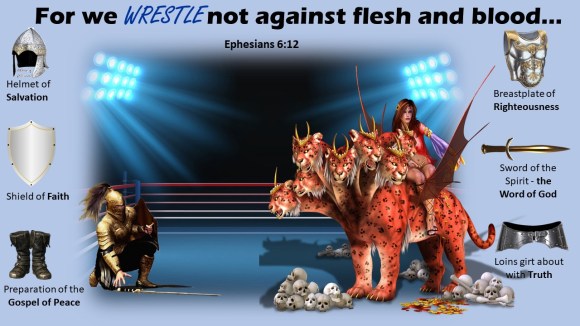
Wrestling was much more common in the ancient times than it is now, because warfare was then a hand-to-hand matter, and victory in a battle depended more on the athletic skill of the combatants, than it does these days of long-range rifles. The great battles were often little else than huge wrestling contests. This is why the Apostle Paul describes the warfare of the Christian as wrestling. “Put on the whole armor of God, that ye may be able to stand against the wiles of the devil. For we wrestle not against flesh and blood, but against principalities, against powers, against the rulers of the darkness of this world, against spiritual wickedness in high places.” Ephesians 6: 11, 12.This contest is to be carried on with the strength that the Lord gives, and the armor that He supplies. The wrestler is exhorted to “be strong in the Lord and in the power of His might.” Ephesians 6:10 He is to strive, but it is to be according to the working of God in him. Colossians 1: 29 The power all comes from God, and it is really God that gains the victory over the enemy, working through the man who yields to Him. Jesus says, “…In the world ye shall have tribulation; but be of good cheer; I have overcome the world.” John 16: 33 Therefore we read, “This is the victory that hath overcome the world, even our faith. And who is he that overcometh the world, but he that believeth that Jesus is the Son of God?” 1 John 5: 4, 5.

In the thirty-sixth Psalm, verses eleven and twelve, (Psalms 36:11, 12) we have a reference to this wrestling against the wickedness of this world. “Let not the foot of pride come against thee, and let not the hand of the wicked remove me. There are the workers of iniquity fallen; they are cast down, and shall not be able to rise.” The hands and feet play the principal part in wrestling. Each wrestler seeks to trip up his antagonist with his feet. There is no foot so dangerous in wrestling as the foot of pride, because “pride goeth before destruction and an haughty spirit before a fall.” (Proverbs 16: 18) Therefore it is that the psalmist prays to be kept from the foot of pride. Only He can keep us from this dangerous foe, because He is meek and lowly in heart. Whoever abides in Him will be kept from the pride of man.

It is an unfortunate thing that most people have made a wrong use of the account of Jacob’s wrestling with the angel, who was the Lord Jesus Himself. They read the account of His wrestling all night, and then in the morning receiving a blessing, and think that means that we are to wrestle with the Lord in order to get a blessing from Him. Because of this mistaken idea, many people fail to receive the blessings that they might otherwise have. Let us study the case a little.

WRESTLING AGAINST GOD

A moment’s thought should be sufficient to show us that the Lord is not our adversary. He is not opposed to us. Therefore we do not have to fight with Him. Wrestling is fighting, and it is a dangerous position for one to occupy, to be fighting against God. God is for us, to protect us from all that come against us. We do not want to fight with the only Friend we have.

But of course the idea of fighting is not in the minds of those who speak of wrestling with God. Their idea is that of striving with Him to get Him to give us His blessing. But God has come to us with His blessing before we ever felt the need of it. “Unto you first God, having raised up His Son Jesus, sent Him to bless you, in turning away every one of you from His iniquities.” Acts 3: 26 “He that spared not His own Son, but delivered Him up for us all, how shall He not with Him also freely give us all things?” Romans 8: 32 If we were half as anxious to receive the blessings of God as He is to bestow them upon us, we should have more than we ever dreamed of.

But did not Jacob wrestle all night with the Lord? Yes, he did, but do not forget that he did not know that it was the Lord. He thought all the time that it was an enemy. And that illustrates the position of those who think that they must wrestle with the Lord for a blessing. Unconsciously they are regarding the Lord as their adversary, instead of their Helper.

Now let us see what we are to learn from the case of Jacob. When was it that he first found that the One with whom he was wrestling was not a man, but the Lord Himself?-It was when the Angel put forth His hand, and put Jacob’s thigh out of joint with a touch. Read the account in Genesis 32: 24-28. How much longer did Jacob wrestle after he found out that he was wrestling with the Lord?-Not a minute, because such a thing was impossible. It was the dislocation of his thigh that made him know with whom he was wrestling; and no man can wrestle with a thigh out of joint. A man with his thigh out of joint would be at a greater disadvantage in wrestling, than a man with only one leg, because in addition to having only one leg to stand on, he would have the inconvenience and the intense pain of the useless one.

What, therefore, did Jacob do as soon as his dislocated thigh made known unto him with whom he was wrestling?-He did the only thing that he could do, namely, he threw his arms around the Lord for support. If one were wrestling or walking, or even standing still, and his thigh should suddenly be thrown out of joint, he would immediately fall to the ground. So Jacob would have fallen, if he had not held on to the Lord. And this we learn from the record. As soon as Jacob’s thigh was out of joint, the Angel said, “Let Me go, for the day breaketh.” And Jacob replied, “I will not let Thee go, except Thou bless me.” This shows, what we should naturally conclude, that as soon as Jacob learned that it was the Lord with whom he was wrestling, he ceased wrestling, and threw himself upon Him for support.

And it was then that Jacob prevailed. During all the night of wrestling he had not been able to gain anything, but as soon as he stopped wrestling with the Lord, and hung helpless upon Him, he gained a blessing. And so it will ever be. “For thus saith the Lord God, the Holy One of Israel; in returning and rest shall ye be saved; and quietness and in confidence shall be your strength.” Isaiah 30: 15 “Trust ye in the Lord for ever; for in the Lord Jehovah is everlasting strength.” Isaiah 26: 4.

Then instead of striving with the Lord, let us yield to Him, and allow Him to do our fighting for us. See Psalms 25: 1, 2. We shall find all that we wish to do, in keeping our wills subject to His. Power belongs to Him, and He will exert all in our behalf, if we will throw ourselves upon Him.

Categories
Bible Truths

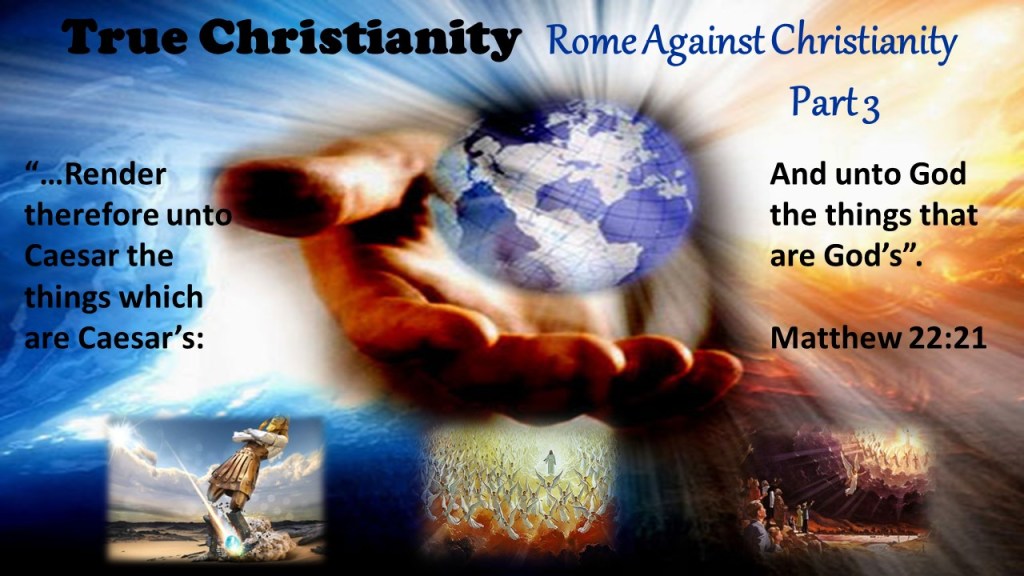
True Christianity: Rome Against Christianity – Part 3

As Christianity began to take root in the Roman empire, the difference between Judaism and Christianity was clearly seen.  While Rome recognized the Jewish religion, the Christian religion was not granted permission to exist.  Therefore, a direct conflict began between Christianity and the most brutal and oppressive of all power, Rome.  Of Rome the Bible states, “Then I would know the truth of the fourth beast, which was diverse from all the others, exceeding dreadful, whose teeth [were of] iron, and his nails [of] brass; [which] devoured, brake in pieces, and stamped the residue with his feet”. (Daniel 7:19 [KJV])

A fundamental maxim of Roman legislation was, — “No man shall have for himself particular gods of his own; no man shall worship by himself any new or foreign gods, unless they are recognized by the public laws.” — Cicero.  [Page 348] Quoted in Neander’s “History of the Christian Religion and Church,” sec. i, div.iii, par. 2.  

It is very evident that in such a system there was no place for individuality. The State was everything, and the majority was in fact, the State. What the majority said should be, that was the voice of the State, that was the voice of “God”, that was the expression of the highest good, that was the expression of the highest conception of right; and everybody must assent to that or be considered a traitor to the State. The individual was but a part of the State. There was therefore no such thing as the rights of the people; the right of the State only was to be considered, and that was to be considered absolute. “The first principle of their law was the paramount right of the State over the citizen. Whether as head of a family, or as proprietor, he had no natural rights of his own; his privileges were created by the law as well as defined by it. The State in the plenitude of her power delegated a portion of her own irresponsibility to the citizen, who satisfied the conditions she required in order to become the parent of her children; but at the same time she demanded of him the sacrifice of his free agency to her own rude ideas of political expediency.” –– Merivale. [Page 349] “Romans under the Empire,” chap. xxii, par.21.

It is also evident that in such a system there was no such thing as the rights of conscience; because as the State was supreme also in the realm of religion, all things religious were to be subordinated to the will of the State, which was but the will of the majority. And where the majority presumes to decide in matters of religion, there is no such thing as rights of religion or conscience. Against this whole system Christianity was diametrically opposed. — {1898 ATJ, Great Empires of Prophecy (GEP) 349.2}

Christ had set himself before His disciples as the one possessing all power in heaven and in earth. He had told them to go into all the world and teach to every creature all things whatsoever He had commanded them. Christ had said that the first of all the commandments, that which inculcates the highest and first of all duties is, “And thou shalt love the Lord thy God with all thy heart, and with all thy soul, and with all thy mind, and with all thy strength:…” (Mark 12:30 [KJV]) This put Jesus Christ above the State, and put allegiance to Him above allegiance to the State; this denied the supremacy of Rome, and likewise denied either, that the Roman gods were gods at all, or that the genius of Rome itself was in any sense a god. {1898 ATJ, GEP 350.1}

Christ when asked by the Pharisees and the Herodians whether it was lawful to give tribute to Caesar or not, answered: “Render therefore unto Caesar the things which are Caesar’s; and unto God the things that are God’s.” (Matthew 22:21 [KJV]) In this, Christ established a clear distinction between Caesar and God, and between religion and the State. He separated that which pertains to God from that which pertains to the State. Only that which was Caesar’s was to be rendered to Caesar, while that which is God’s was to be rendered solely to God.

Therefore when Christ made this distinction between God and Caesar, separated that which pertains to God from that which pertains to Caesar, and commanded men to render to God that which is God’s, and to Caesar only that which is Caesar’s, He at once stripped Caesar — the State — of every attribute of divinity. And in doing this, He declared the supremacy of the individual conscience; because it rests with the individual to decide what things they are which pertain to God. {1898 ATJ, GEP 350.4}

 Thus Christianity proclaimed the right of the individual to worship according to the dictates of his own conscience; Rome asserted the duty of every man to worship according to the dictates of the State. Christianity asserted the supremacy of God; Rome asserted the supremacy of the State. Christianity set forth God as manifested in Jesus Christ as the chief good; Rome held the State to be the highest good. Christianity set forth the law of God as the expression of the highest conception of right; Rome held the law of the State to be the expression of the highest idea of right. Christianity taught that the fear of God and the keeping of His commandments is the whole duty of man; Rome taught that to be the obedient servant of the State is the whole duty of man. Christianity preached Christ as the sole possessor of power in heaven and in earth; Rome declared the State to be the highest power. Christianity separated that which is God’s from that which is Caesar’s; Rome maintained that that which is God’s is Caesar’s.  {1898 ATJ, GEP 351.1}

With the distinction clearly made, to profess Christianity made you an enemy of the state, but such was the calling.  “And they overcame him by the blood of the Lamb, and by the word of their testimony; and they loved not their lives unto the death”. (Rev 12:11 [KJV])

Rome had a pantheon of gods, and every act of life was associated with the gods.  Every Christian, merely by the profession of Christianity, severed himself from all the gods of Rome and everything that was done in their honor. He could not attend a wedding or a funeral of his nearest relatives, because every ceremony was performed with reference to the gods. He could not attend the public festival, for the same reason. Nor could be escape by absenting himself on such occasions; because on days of public festivity, the doors of the houses, and the lamps about them, and the heads of the dwellers therein, must all be adorned with laurel and garlands of flowers in honor of the licentious gods and goddesses of Rome. If the Christian took part in these services, he paid honor to the gods as did the other heathen. If he refused to do so, which he must do if he would obey God and honor Christ, he made himself conspicuous before the eyes of the people, all of whom were intensely jealous of the respect they thought due to the gods. Also, in so refusing, the Christians disobeyed the Roman law, which commanded these things to be done. {1898 ATJ, GEP 358.1}

 All this subjected the Christians to universal hatred, and as the laws positively forbade everything that the Christians taught, both with reference to the gods and to the State, the forms of law furnished a ready channel through which this hatred found vent. This was the open way for the fury of the populace to spend itself upon the “deniers of the gods, and enemies of the Caesars and of the Roman people.” And this was the source of the persecution of Christianity by pagan Rome. 
{1898 ATJ, GEP 358.2}  

One of the ruling principles of law in the Roman State was this: — {1898 ATJ, GEP 359.4}

“Whoever introduces new religions, the tendency and character of which are unknown, whereby the minds of men may be disturbed, shall, if belonging to the higher rank, be banished; if to the lower, punished with death.” {1898 ATJ, GEP 359.5}

Nothing could be more directly condemned by this law than was Christianity. {1898 ATJ, GEP 359.6}

In spite of all this, Christianity flourished till it was said;  “ If ye continue in the faith grounded and settled, and [be] not moved away from the hope of the gospel, which ye have heard, [and] which was preached to every creature which is under heaven; whereof I Paul am made a minister; (Col 1:23 [KJV])

True Christianity was not only willing to suffer reproach but die for the sake of the gospel. Are you a true Christian?

“But what things were gain to me, those I counted loss for Christ. Yea doubtless, and I count all things [but] loss for the excellency of the knowledge of Christ Jesus my Lord: for whom I have suffered the loss of all things, and do count them [but] dung, that I may win Christ”. (Phil 3:7-8 [KJV])

Categories
Bible Truths

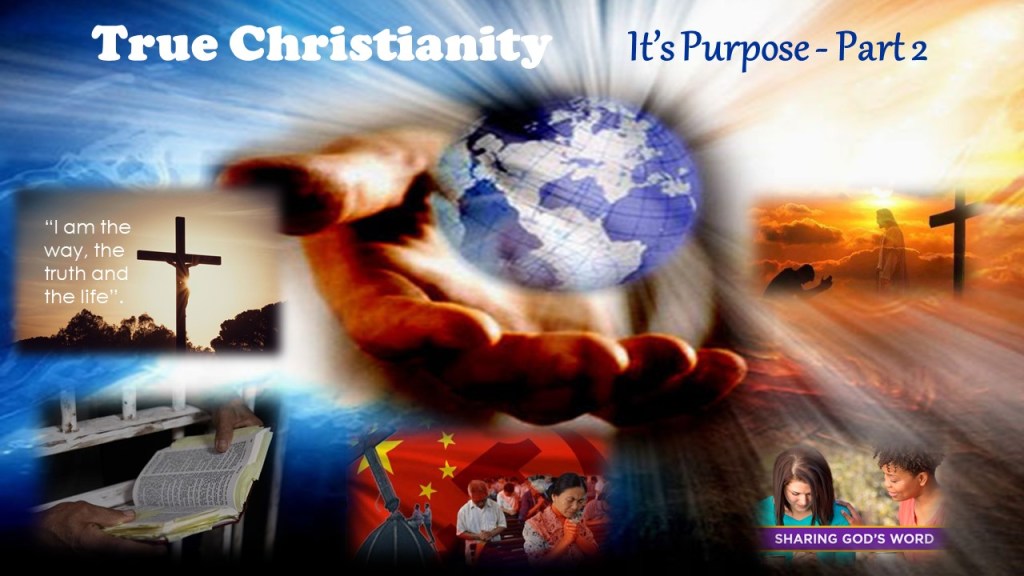
True Christianity: It’s Purpose – Part 2

Of Jesus it is said, “Behold the Lamb of God, which taketh away the sin of the world.” (John 1:29) He was sent to reveal the Father’s character amongst the most despotic of all nations, as a sheep among wolves.

Christ came to make men free, The Spirit of the Lord [is] upon me, because he hath anointed me to preach the gospel to the poor; he hath sent me to heal the brokenhearted, to preach deliverance to the captives, and recovering of sight to the blind, to set at liberty them that are bruised.” (Luke 4:18 [KJV])

The Roman Empire then filled the world,  “the sublimest incarnation of power, and a monument the mightiest of greatness built by human hands, which has upon this planet been suffered to appear.” That empire, proud of its conquests, and exceedingly jealous of its claims, asserted its right to rule in all things, human and divine. In the Roman view, the State took precedence of everything. It was entirely out of respect to the State and wholly to preserve the State, that either the emperors or the laws ever forbade the exercise of the Christian religion. According to Roman principles, the State was the highest idea of good. “The idea of the State was the highest idea of ethics, and within that was included all actual realization of the highest good; hence the development of all other goods pertaining to humanity, was made dependent on this.” — Neander. 5  {1898 ATJ, Great Empires of Prophecy (GEP) 346.4}

 Man with all that he had, was subordinate to the State; he must have no higher aim than to be a servant of the State; he must seek no higher good than that which the State could bestow. Thus every Roman citizen was a subject, and every Roman subject was a slave. “The more distinguished a Roman became, the less was he a free man. The omnipotence of the law, the despotism of the rule, drove him into a narrow circle of thought and action, and his credit and influence depended on the sad austerity of his life. The whole duty of man, with the humblest and greatest of the Romans, was to keep his house in order, and be the obedient servant of the State.” — Mommsen. 6   {1898 ATJ, GEP 347.1}

Jesus Christ came into the world to set men free, and to plant in their souls the genuine principle of liberty, — liberty actuated by love, liberty too honorable to allow itself to be used as an occasion to the flesh or for a cloak of maliciousness. Liberty led by a conscience enlightened by the Spirit of God, liberty in which man may be free from all men, yet made so gentle by love that he would willingly become the servant of all, in order to bring them to the enjoyment of this same liberty. This is freedom indeed. This is the freedom which Christ gave to man; for “whom the Son makes free is free indeed.” {1898 ATJ, GEP 346.1}

Rome in conquering the nations, did not interfere with their religious services.  To the Romans, all religion was simple superstition. See Acts 25:19.

The conquered is allowed to worship, as long as they acknowledge that Caesar is God above all others, in another word, Caesar was the supreme “God”. 

The controversy that arose between the Christians and the Romans was not a dispute between individuals, or a contention between sects or parties. It was a contest between antagonistic principles.  Christianity demanded absolute freedom of conscience, the right of the individual to worship God as he or she saw fit.  On the part of Rome, it was the assertion that Caesar was the highest and every other god is subservient to Caesar. Caesar was the State and the State rules in all things, divine as well as human, religious as well as civil.

It became clear that for any man to profess the principles and the name of Christ was virtually to set himself against the Roman Empire.  For him to recognize God as revealed in Jesus Christ as the highest good, was but treason against the Roman State. It was not looked upon by Rome as anything else than high treason; because, as the Roman State represented to the Roman the highest idea of good, for any man to assert that there was a higher good, was to make Rome itself subordinate. And this would be a direct blow at the dignity of Rome, and subversive of the Roman State. Consequently the Christians were not only called “atheists,” because they denied the gods, but the accusation against them before the tribunals was of the crime of “high treason,” because they denied the right of the State to interfere with men’s relations to God. The common accusation against them was that they were “irreverent to the Caesars, and enemies of the State and Caesar.

In trying to trap Jesus the Pharisees asked; “Is it lawful to give tribute unto Caesar, or not?  “ Then saith he unto them, Render therefore unto Caesar the things which are Caesar’s; and unto God the things that are God’s.” (Matt 22:21 [KJV])

With this declaration, Jesus made it clear that Caesar’s role was civil only, and everything dealing with conscience is to God.  He made it clear that Caesar was not God.  To the Christians were given the commands, “Thou shalt have no other gods before me” (Exodus  20:1). Thou shalt worship the Lord thy God, and him only shalt thou serve”.  
(Matt 4:10 [KJV])“Look unto me, and be ye saved, all the ends of the earth: for I [am] God, and [there is] none else”. (Isa 45:22 [KJV]) These texts were clear and there could be no compromise. 

Therefore to acknowledge Christianity and profess that you are a follower was literally a death sentence.  That has always and will always be the path to true Christianity.  Then said Jesus unto his disciples, If any [man] will come after me, let him deny himself, and take up his cross, and follow me.” (Matt 16:24 [KJV])

In matters of conscience the soul must be left untrammeled. No one is to control another’s mind, to judge for another, or to prescribe his duty. God gives to every soul freedom to think, and to follow his own convictions. “Every one of us shall give account of himself to God”. No one has a right to merge his own individuality in that of another. In all matters where principle is involved, “let every man be fully persuaded in his own mind”. (Romans 14:12, 5). In Christ’s kingdom there is no lordly oppression, no compulsion of manner. Desire of Ages (DA) 551

True Christianity  is founded and built on  liberty of conscience.  See (Acts chapter 4 and  5:17-33).  He who follows the multitude to force one to violate his conscience is not Christian.    

“For I am come to set a man at variance against his father, and the daughter against her mother, and the daughter in law against her mother in law.  And a man’s foes [shall be] they of his own household.  He that loveth father or mother more than me is not worthy of me: and he that loveth son or daughter more than me is not worthy of me.  And he that taketh not his cross, and followeth after me, is not worthy of me.  He that findeth his life shall lose it: and he that loseth his life for my sake shall find it”. (Matt 10:35-39 [KJV])

**True Christianity: The Conclusion. Part 3 to follow**

Categories
Bible Truths

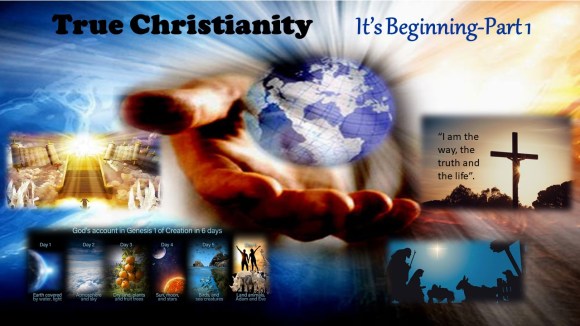
True Christianity: It’s Beginning – Part 1

Just before Christ was born into this world, the religions of the world had degenerated to such an extent that they no longer had any light. The way to heaven was lost and truth had fallen into the street. The birth of Christ began the restoration of all that was lost. Of himself, Jesus says “I am the way, the truth, and the life: no man cometh unto the Father, but by me”. (John 14:6 [KJV])

Inspiration had foretold that in the fullness of time Christ would come, and at the darkest hour of human life.

“But when the fullness of the time was come, God sent forth his Son, made of a woman, made under the law,  To redeem them that were under the law, that we might receive the adoption of sons”. (Galatians 4:4-5 [KJV])

As a nation, the gospel was commissioned to the Jews to keep the way, the truth and the life before the world but they gradually lost it.

“When the fullness of the time was come, God sent forth His Son.” Providence had directed the movements of nations, and the tide of human impulse and influence, until the world was ripe for the coming of the Deliverer. The nations were united under one government. One language was widely spoken, and was everywhere recognized as the language of literature. From all lands the Jews of the dispersion gathered to Jerusalem to the annual feasts. As these returned to the places of their sojourn, they could spread throughout the world the tidings of the Messiah’s coming. 
{Desire of Ages (DA) 32.2}

“As the Jews had departed from God, faith had grown dim, and hope had well-nigh ceased to illuminate the future. The words of the prophets were uncomprehended. To the masses of the people, death was a dread mystery; beyond was uncertainty and gloom. It was not alone the wailing of the mothers of Bethlehem, but the cry from the great heart of humanity, that was borne to the prophet across the centuries,–the voice heard in Ramah, “lamentation, and weeping, and great mourning, Rachel weeping for her children, and would not be comforted, because they are not.” Matthew 2:18. In “the region and shadow of death,” men sat unsolaced. With longing eyes they looked for the coming of the Deliverer, when the darkness should be dispelled, and the mystery of the future should be made plain”. 
{DA 32.4}    

Through heathenism, Satan had for ages turned men away from God; but he won his great triumph in perverting the faith of Israel. By contemplating and worshiping their own conceptions, the heathen had lost a knowledge of God, and had become more and more corrupt. So it was with Israel. The principle that man can save himself by his own works lay at the foundation of every heathen religion; it had now become the principle of the Jewish religion. Satan had implanted this principle. Wherever it is held, men have no barrier against sin.  {DA 35.2} 

The people whom God had called to be the pillar and ground of the truth had become representatives of Satan. They were doing the work that he desired them to do, taking a course to misrepresent the character of God, and cause the world to look upon Him as a tyrant. The very priests who ministered in the temple had lost sight of the significance of the service they performed. They had ceased to look beyond the symbol to the thing signified. In presenting the sacrificial offerings they were as actors in a play. The ordinances which God Himself had appointed were made the means of blinding the mind and hardening the heart. God could do no more for man through these channels. The whole system must be swept away.  {DA 36.2}

Sin had become a science, and vice was consecrated as a part of religion. Rebellion had struck its roots deep into the heart, and the hostility of man was most violent against heaven. It was demonstrated before the universe that, apart from God, humanity could not be uplifted. A new element of life and power must be imparted by Him who made the world{DA 37.1} 

 It is into this darkness that Christ was born. 

“And it came to pass in those days, that there went out a decree from Caesar Augustus, that all the world should be taxed. ([And] this taxing was first made when Cyrenius was governor of Syria.) And all went to be taxed, every one into his own city. And Joseph also went up from Galilee, out of the city of Nazareth, into Judaea, unto the city of David, which is called Bethlehem; (because he was of the house and lineage of David:)  To be taxed with Mary his espoused wife, being great with child. And so it was, that, while they were there, the days were accomplished that she should be delivered.  And she brought forth her firstborn son, and wrapped him in swaddling clothes, and laid him in a manger; because there was no room for them in the inn”. (Luke 2:1-7 [KJV])

Rome ruled the world. In fact it is said Rome was the world.  Having adopted the Grecian culture and philosophy, all the iniquity of Greece was now Roman.

Into that world of iniquity, Jesus Christ was sent, as a sheep among wolves, a little band of disciples carrying hope to the despairing, joy to the sorrowing, comfort to the afflicted, relief to the distressed, peace to the perplexed, and to all a message of merciful forgiveness of sins, of the gift of the righteousness of God, and of a purity and power which would cleanse the soul from all unrighteousness of heart and life, and plant there instead the perfect purity of the life of the Son of God and the courage of an everlasting joy. This gospel of peace and of the power of God unto salvation they were commanded to go into all the world and preach to every creature.
{1898 ATJ, Great Empires of Prophecy (GEP) 343.2}

Next, True Christianity: It’s Purpose – Part 2